
I know there are people who look at what I do at Prompt-Lee with skepticism. I know some feel that music created with AI isn’t “real” music, or that spoken words and generated sound somehow count for less. I understand those feelings — and I respect where they come from.
At Prompt-Lee, my responsibility is to explore how we can work with modern technology, not just be consumed by it. We offer users a range of tools: genre and instrument prompts, lyrical generators, and now, new AI prompts designed to help writers measure and judge their own work. For me, this isn’t just about adopting new technology; it’s about retaining creative control — ensuring our engagement with creativity remains deeply human, even as the tools around us change.
But the real importance of this technology, for me personally, began during a time when I was away from it for several years. While I was in prison, I did a great deal of writing. Even before that, life was so demanding that my interaction with technology was minimal. When I came home after seven years and seven months in various places, I had stacks of poetry I’d written by hand. Sitting down at my computer to type them up, I discovered AI and generative music.

Suddenly, those words written in a cell took on a whole new dynamic. I could turn my poetry into something more — spoken words, songs, something that carried the feeling behind the words. There was a new heart, a new feel, a way of expressing deep emotional things I’d struggled to communicate through raw words alone. I know not everyone wants to read thousands of words, so being able to bring my prison poetry to life through music and spoken word helped me feel I was truly connecting — communicating my experience in a way that reaches further than text alone.
This is what matters most to me. Generative AI music isn’t just a tool; it is a way to give voice to what I carry inside. It matches the atmosphere I feel, and it ensures that the feeling — the soul — becomes what matters most.
What I Use AI Music For
Beyond that personal discovery, how do I actually use it? It has become an indispensable bridge between what I write and how I share it.
I spend a lot of time writing about theology, philosophy, and life experiences. When I complete an article, I want to make its core message accessible to people who may not have the time or inclination to read it all. That is where generative capabilities truly shine. I can shape those ideas into something people can listen to — something that carries both words and music. It reaches those who prefer to hear rather than read, and it connects on a different level entirely.
I also love to write my own songs, but I play very minimal instruments. I have a little guitar and keyboard experience, but that is where my musical ability ends. With generative music, I can create songs built entirely from my words, my structure, my emotions, and my experience. I provide the intent — the AI gives those words rhythm, soul, and style. And using Prompt-Lee’s own prompters, I can design exactly what it becomes: orchestral, rock, contemporary Christian, spoken word, or even opera. That freedom lets me speak to a much wider audience, tailoring the sound to match the message.

Beyond creation, I use it simply to help myself feel better. On days when I’m not well — when I’m having a difficult autistic day and everything feels overwhelming — listening to music that expresses exactly where I am helps me navigate life better. It is a form of emotional resonance that grounds me.
What It Makes Me Feel — And Its Impact on My Creativity
More than anything, generative music makes me feel heard. When I guide it toward the tone, the mood, the feeling I’m reaching for, and it responds — it feels like something is meeting me halfway. It does not replace inspiration; it unlocks it. It removes the barrier between the music I can hear in my head and the music I can actually bring into the world.
Sometimes, I feel confused about my own emotions. Anyone on the autistic spectrum can probably relate to that. When I write words down, reach for my thesaurus, and gather resources to help me express what I feel, I want to connect those ideas so that I myself can understand them more deeply. I want to hear my own experience. And generative AI music helps me do exactly that.
There is also something wonderful about taking an old hymn, an old song, or an old piece of poetry — something written long ago — and breathing fresh life into it. Through the prompters and generative tools, I can hear those familiar words speak anew. I spend a great deal of time doing exactly that: taking treasures from the past and letting them speak again, in a voice for today.
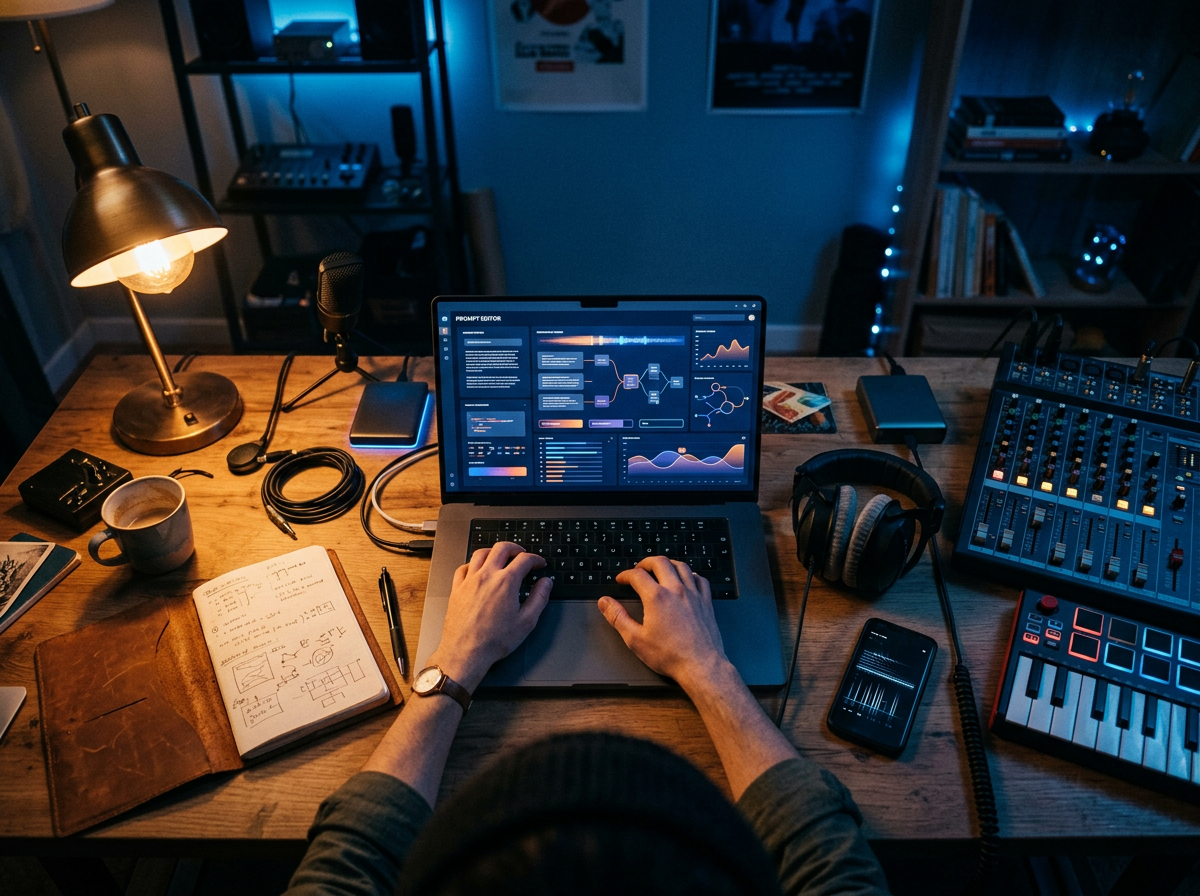
And there is that moment of creation itself. I type in what I imagine. I choose the style, the mood, the voice. I push the button. There is a moment of anticipation — the wheels turning, the calculation, the forming of something from what I asked. Then I push play.
That moment — when my words, my ideas, my choices, and the music come together — is pure excitement. It feels like collaboration. Sometimes I move to it, relax to it, sing along. Sometimes I simply close my eyes and listen to the instrumentation, letting the music carry me where it will.
This is where my imagination truly takes flight. Imagine being able to hire exactly the musicians you need — a jazz band, a rock ensemble, an opera singer, a full orchestra. For most people sitting at home, that is impossible. Where would I find the means to hire professional singers, drummers, keyboardists, guitarists, bassists, cellists, flautists? How could I afford to bring together the talent and skill to realise what I hear inside?
Yet with generative AI, what would have cost thousands upon thousands of dollars is available through a simple subscription — limited only by my imagination, my prompts, and the boundaries of the tools.

This revolutionises how I relate even to myself. It makes me feel good, excited, empowered. It lets me experience myself and what I feel in ways that sometimes feel distant to me. It frees me from the limitation of not being a trained musician, so that the feeling — the soul of the music — becomes what matters most. Instead of being blocked by technique, I am freed by possibility.
How the Freedom of Creativity Broadens My Communication
This freedom also fundamentally changes how I communicate. Suddenly, I can express things connected not just to my writing, but to my thinking, my poetry, and my life experience — in ways that are richer, more resonant, and more complete.
I am realistic: not everyone wants to read thousands of words of theology and philosophy. That is perfectly fine. But now, through generative music, I can reach those people in a different way. I can invite them into my world without asking them to read an article. I can say: “Here is a thought. Here is something I’d like to share.”
It also lets me communicate ideas from a perspective that may not come through clearly in text alone. It gives me freedom — freedom to say what I mean in more than one way, freedom to express what matters through sound as well as word. The music carries what the words alone could not. And so, my audience expands. My communication becomes fuller. And people who might never have read my work can still hear what I have to say.
Conclusion
So when people question what I do, or dismiss AI music as something less, I want them to know this: it is not about replacing human creativity. It is about unlocking mine.
My journey — from handwritten words in a cell to the tools I use today — has shown me that generative music bridges the gap between what I imagine and what I can share. I provide the words, the structure, the emotion, the intent, and the choice. The tool helps me realise it. Together, we create something neither of us could have made alone.
It gives me access to musical expression that was once financially impossible. It lets me revisit old treasures and hear them speak fresh. It lets me communicate beyond the page, inviting others into what I carry. And most of all, it allows me to say what I mean — in the way it was always meant to be heard.


Leave a Reply