Introduction
Like many of you, I probably spend a good amount of time scrolling through YouTube and other social media. Sometimes my thumb gets tired, flicking through endless chats, ideas, and social interactions. Sometimes it’s just quick reels; other times, I dive into more substantial content.

But one thing is certain, and I’ve noticed this transition over my lifetime—having been involved with technology since the early days of the internet and social platforms: social media has profoundly divided us.
It’s tempting to blame the platforms themselves, and they certainly play a role. But I suspect the deeper problem—the one we face not just online but in society and nations—is less about the technology and more about us. It is about human maturity and insightfulness.
If I were to offer an easy answer to this complex problem, it would be this: human beings often lack the maturity and resilience to face diverse opinions.
The Warning: A Principle for Our Times
The divisions we see, the violence born of intolerance, the very tribalism that prevents us from maturing—these are not new problems. But the wisdom to combat them is ancient and profound.
John Stuart Mill, in his seminal work On Liberty, offers a principle that is as challenging today as it was when he wrote it:
“If all mankind minus one, were of one opinion, and only one person were of the contrary opinion, mankind would be no more justified in silencing that one person, than he, if he had the power, would be justified in silencing mankind. Were an opinion a personal possession of no value except to the owner; if to be obstructed in the enjoyment of it were simply a private injury, it would make some difference whether the injury was inflicted only on a few persons or on many. But the peculiar evil of silencing the expression of an opinion is, that it is robbing the human race; posterity as well as the existing generation; those who dissent from the opinion, still more than those who hold it. If the opinion is right, they are deprived of the opportunity of exchanging error for truth: if wrong, they lose, what is almost as great a benefit, the clearer perception and livelier impression of truth, produced by its collision with error.”
— John Stuart Mill, On Liberty
Mill’s argument, in essence, is a powerful warning against the suppression of opinion, no matter how unpopular or contrary to the majority. He argues that:
- Numbers do not grant the right to silence: Whether it’s one person against the world, or the world against one person, suppressing an opinion is fundamentally illegitimate. Might does not make right.
- Silencing harms everyone: It is not just a private injury to the speaker. It robs society—present and future generations—of the chance to learn, grow, and refine truth.
- Even wrong opinions have value: If an opinion is wrong, challenging it helps us understand the truth more deeply. If it is right, we gain the truth itself. The collision of ideas is essential for intellectual and societal maturation.
This is the core of Mill’s challenge: our current tendency to silence dissent, demonize opposing views, and retreat into our own tribes is not a sign of strength or conviction—it is a profound weakness that robs us all.
But here’s a deeper layer, a vital check on our own hearts. We might think we are defending truth or righteousness when we seek to silence an opinion we deem wrong. We might believe we are upholding a clear line. Yet, even with the best intentions, our own hearts can be divided.
Are we truly seeking truth, or are we seeking to perform, to stand out, or simply to reinforce our own comfort and tribal belonging?

As Søren Kierkegaard reminds us: “Purity of heart is to will one thing”—and how easily our will can be divided, wanting the good while also wanting approval, or wanting truth while also wanting to win.
Mill’s warning highlights how easily we can look right in our choices about what society is exposed to. There is, of course, a line that ought not to be crossed. But how often do we cross that line long before any real harm occurs—through verbal abuse, trolling, shutting down conversation, blocking, silencing, or closing platforms simply because we dislike what we hear?
That impulse—to cut off rather than engage—so often passes itself off as defending truth, when in fact it can reveal a divided heart. We do not always understand what we lose when we shut down voices that might bring us discomfort.
The point of sandpaper is to prepare the wall for that layer that finishes it as it ought to be.
The Practicum: Beyond the Echo Chamber
So, what does this mean for us, living in this age of instant reactions and deep divisions?
It means we must cultivate a different kind of strength—not the strength of silencing, but the strength of resilience and discernment.
Mill’s wisdom, coupled with the reminder of a pure heart, calls us to:
- Resist the Impulse to Silence: When faced with an opinion that challenges us, our first instinct might be to dismiss, block, or argue aggressively. Instead, pause. Ask yourself: Is this opinion causing direct harm, or is it simply different? Can I listen, even if I disagree? Can I understand why someone might hold this view, even if I believe it is wrong? This isn’t about agreeing; it is about acknowledging the other person’s humanity and their right to express their perspective.
- Seek Understanding, Not Just Victory: If our aim is truly truth, then engaging with opposing views is essential. Instead of preparing our counter-arguments before the other person has even finished speaking, try to genuinely understand their perspective. What are their underlying assumptions? What experiences shape their view? Truly listening to understand is the very collision of ideas Mill spoke of, and it vitalizes our own understanding of truth.
- Examine Our Own Motives: This is where the “divided heart” comes into play. Before reacting, ask: Am I engaging because I genuinely seek truth and understanding, or because I want to prove myself right, win an argument, or feel superior? Is my desire to silence coming from conviction, or from fear, tribal loyalty, or a need for validation? This self-reflection is the bedrock of maturity.
- Embrace the Discomfort: Engaging with differing opinions can be uncomfortable. It challenges our assumptions and can feel like a threat to our identity or our group. True growth, however, happens in that discomfort. It is in wrestling with ideas that our own convictions become clearer, stronger, and more deeply understood.
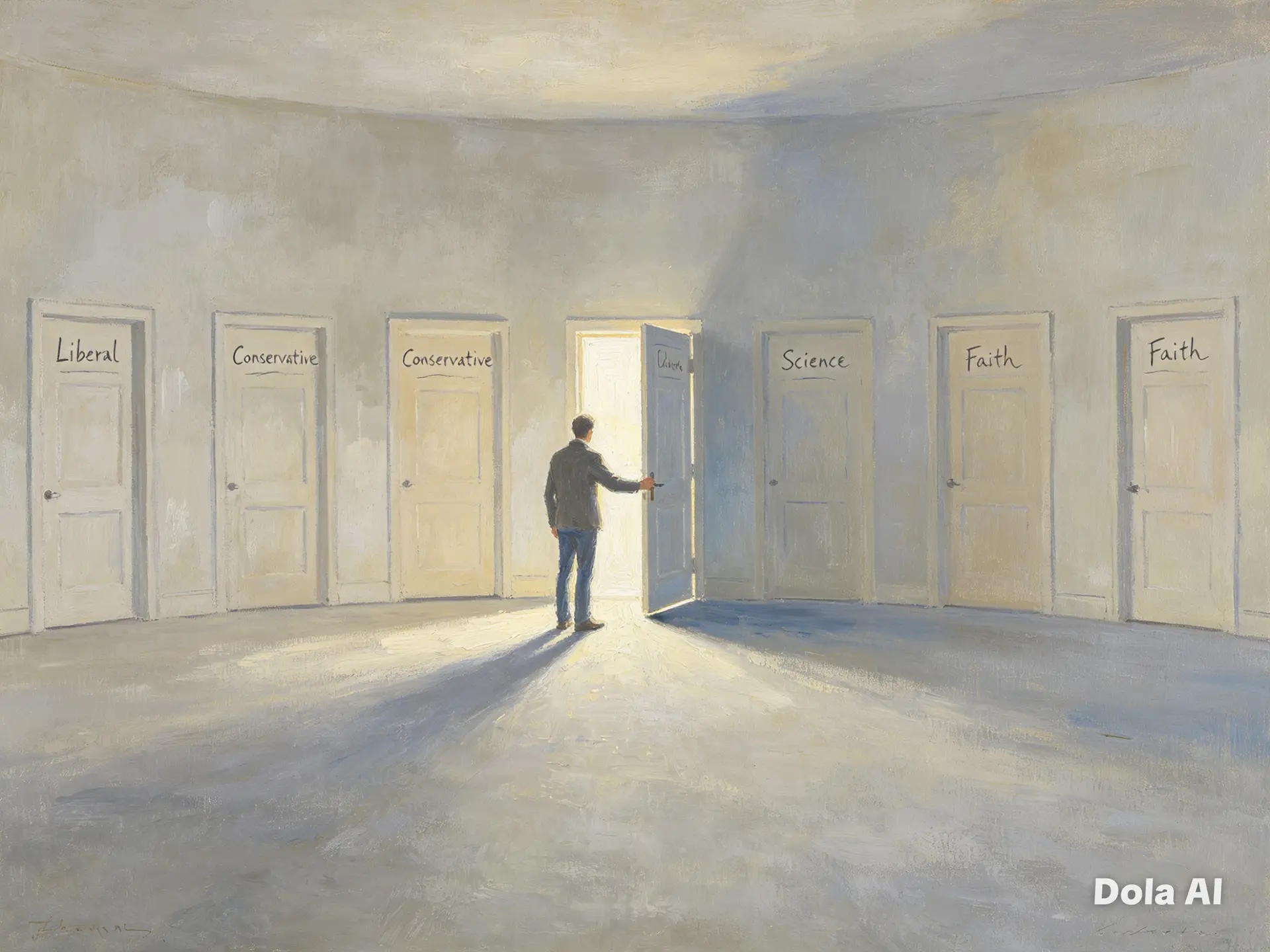
Moving beyond the echo chamber requires courage. It requires the maturity to face ideas we disagree with—not with hostility, but with a willingness to listen, learn, and refine our own understanding.
It is in this space of open, honest, and respectful engagement that we can truly mature, transcend tribalism, and move closer to a more unified, insightful society.

Consider this analogy: It has taken millennia, and countless fallen structures, to learn how to build buildings resilient to earthquakes. Many designs have failed; many concepts lacked the necessary strength. But through those trials, through the testing of materials and ideas, we have developed structures that can withstand immense pressure.
Engaging with people who disagree with us is much the same.
It tests our resilience, our logic, our insight, our knowledge, and our wisdom. It tests our worldview, our hope, and our faith.
And in this testing, that which is not structurally sound falls away, allowing us to build a worldview—and a way of engaging—that is truly able to exist in the reality we find ourselves in.
The Conclusion: A Call to Courage
Mill’s wisdom, Kierkegaard’s insight into the divided heart, and the analogy of building resilient structures all point us toward a fundamental challenge we must face, not just in society, but within our own reality:
Are we courageous?
Living life authentically, engaging with reality as it is, is an inherently courageous act. This is something learned through experience—be it through health challenges, difficult circumstances, or the unique perspectives that come from conditions like autism.
If there’s one thing learned through such journeys, it’s this: it takes courage to face reality.
But courage isn’t born of stubborn pride, closed-off views, or arrogance. True courage requires something more: resilience and determination. It arises from a deep-seated commitment to what is right, honourable, good, and beautiful.
It is in embracing this kind of courage—a courage rooted in truth and integrity—that we strengthen our own resilience.
By realizing this, we open ourselves to something far more wonderful, far deeper, and far more possible:
“a life lived in genuine engagement with reality, built on foundations that can truly stand.“




Leave a Reply