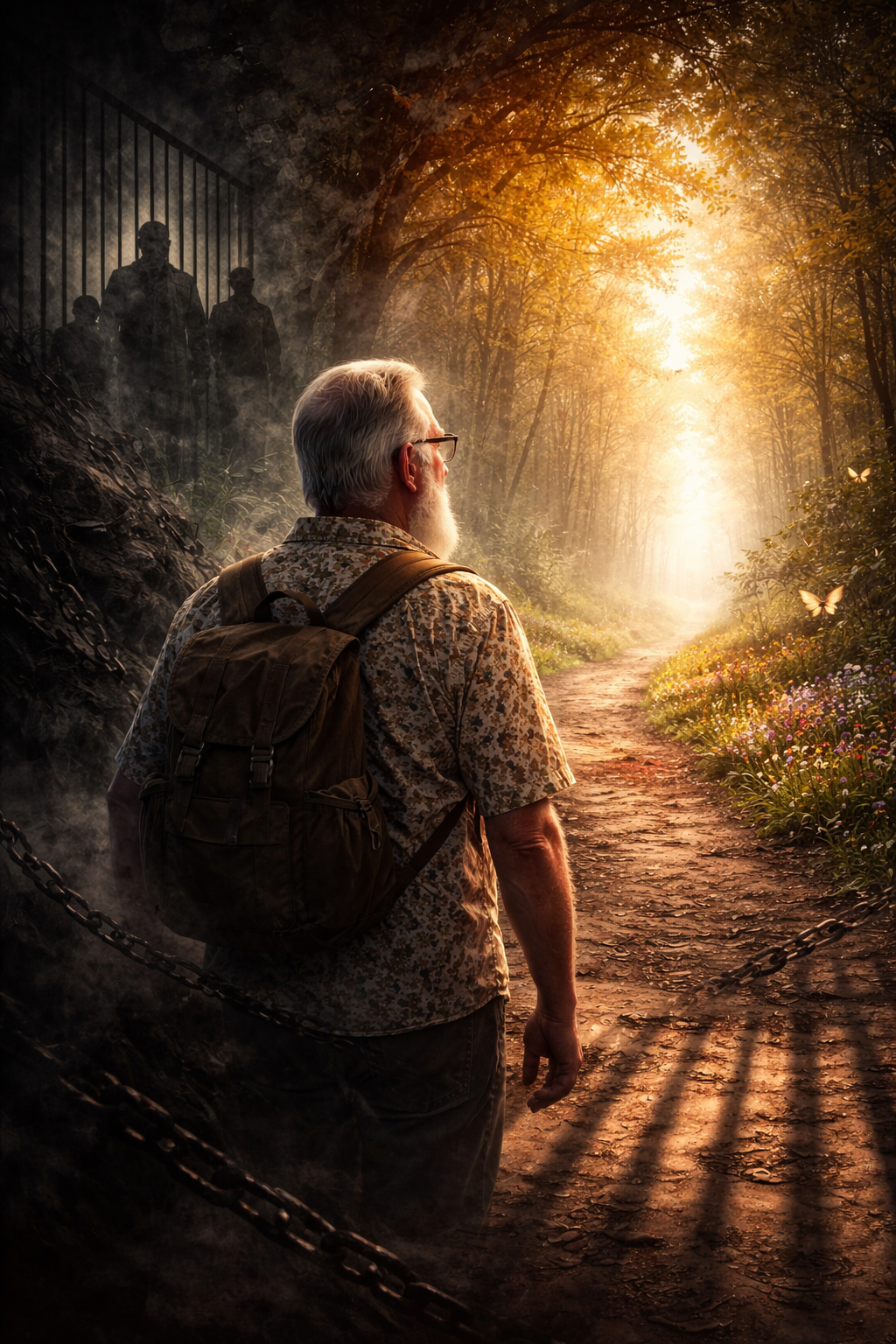
They tell me I’m free now. The GPS is coming off my ankle in a matter of weeks. But freedom, I’m learning, isn’t as simple as unlocking a door. It’s a tangled web of anticipation and fear, of liberation and vulnerability. It’s a promise whispered with one breath and snatched away with the next.
Introduction
My journey has been shaped by a series of experiences that have not only defined who I am but also influenced my perspective on life. Each challenge I faced became a stepping stone, teaching me resilience and the art of adaptability.
I often reflect on the moments of joy and sorrow, how they intertwined to create a rich tapestry of lessons. The relationships I’ve cultivated along the way also played a crucial role; they have nurtured my growth and provided support during tough times.
This reflection serves to remind me of the importance of introspection. Each experience contributes to a greater understanding of self and purpose. I strive to carry these insights forward, embracing both the light and shadows of my past as I navigate the future.
For nearly two years and seven months, I lived within the confines of a prison sentence, accused of things I still vehemently deny to this day. With nearly four years and three months—counting the 19 months of parole—of this strange, paradoxical, and stressful time coming to an end, I have been reflecting on “What next?”—a question that carries the cost of restriction and the physical and internal weight such experiences inevitably bring.

But as I approach that finish line, I find myself grappling with a profound paradox: the promise of freedom is intertwined with the very anxieties that haunted my captivity.
How do you embrace a future when the past refuses to be reasoned away? How do you reconcile the person you know yourself to be with the “horrific story” imposed upon you? This blog is an exploration of that dissonance—a journey into a world where the truth is often obscured by assumptions, and where the promise of freedom is constantly shadowed by the fear of losing it all again.
The Genesis of Dissonance
This world of contradiction didn’t begin on the day I walked out of prison. Its roots were planted long before, in the second year of my sentence.
That’s when my body began to betray me—a physical manifestation of the psychological turmoil. Ulcers erupted on my arms, legs, and even inside my ears—a constant, throbbing reminder that I was not recovering from the trauma of the accusations and trial.
My dreams became battlegrounds of paradox, and even with therapy, I couldn’t shake the feeling that something fundamental had shifted.
“The shame I felt wasn’t guilt, but an abstract shame born from being judged and ostracized for something I didn’t do.”
This led me to distrust the very fabric of society—the systems and people I had once held in high regard. Even now, years later, I sometimes find myself reacting unconsciously around authority figures, a subconscious echo of that trauma. To speak my truth risks being labeled a “victim blamer,” a silencing mechanism that forces me to be extraordinarily cautious.
Looking Back as I Look Forward
I would love to plan for the future, but everything I do is shadowed by my past—my trial, my imprisonment, the actions of the police and the system. It’s difficult to move forward when I know from bitter experience that “the crowd is untruth,” and that those in power are flawed humans.
I remember one incident vividly: a police officer accused me of breaking a rule, even when it was proven I hadn’t. He yelled, advanced on me, and called me names and threatening my sense of safety. My instinct was to defend myself, but I couldn’t. Touching him would have meant facing further charges, with no guarantee of being believed.
That encounter has stayed with me. It made me realise that those I once trusted are not infallible. This experience has fundamentally changed how I look forward, making every step a cautious negotiation with the ghosts of the past.
The Instinct to Hide
This realisation fuels a powerful drive to retreat. I find myself wanting to buy land, set up a tiny home—perhaps even a small family compound—and hide away from the world.
My instinct for isolation has grown stronger than ever. While I cherish my loved ones, the crowd itself feels untrustworthy and overwhelming, triggering my PTSD and unsettling my sense of safety. Even a simple walk downtown with my wife, Tania, becomes an exercise in vigilance: scanning windows, checking surroundings, clenching my fists. These habits, picked up in prison, still linger.
The mere idea of seeing someone I don’t want to see can trigger a safety alert in my system—a deeply ingrained instinct for self-preservation that makes planning for a truly free future a monumental challenge.
Living with the Echoes
My life now is a testament to the ongoing consequences of those accusations. While I’ve found meaningful work developing a game with Tiny Indie, the prospect of traditional employment feels insurmountable. Along with this game development, I spend time blogging, writing articles and dipping my hand into book authorship.
The physical exhaustion, constant pain, and the way my body shuts down make functioning in a conventional environment extremely difficult. I fall asleep unexpectedly, become hypersensitive to noise and light, and even a dropped object can send a shock through my system.
This is a direct consequence of the trauma—a reminder of the power we wield when we inflict harm, avoid responsibility, or act on impulses like fear or revenge. Those who choose to accuse and cause harm are rarely aware of the profound and lasting consequences they set in motion.
The Unvarnished Reality
We live in an extraordinary, complicated world, deeply interconnected in ways that bring both good and terrible things into our lives. My experience has shown me that the world is not a safe place, and that people can be dangerous—especially when integrity does not govern them.
The physical costs are undeniable: ulcers, teeth grinding from sustained tension, a surgical wound struggling to heal due to low immunity, functional neurological disorder bringing widespread pain, and non-organic seizures. I don’t feel the world is safe, and I can’t easily return to the things I once loved. These are heavy, uncomfortable, and unstable realities.
The Burden of Incoherence
The depth of this challenge is amplified by my neurodiversity. My brain is wired to seek patterns, fairness, and a logical “why”—elements that the legal system and the “crowd” are simply not designed to provide. For many, an unresolved injustice is a heavy burden; for me, it is a constant cognitive friction that feels like physical static.
When the world stops making sense, the lack of resolution becomes an almost unbearable weight. My mind reaches for a coherence that isn’t there, trying to close a file that the system has left permanently agape. I love life, and I am not suicidal—but I am often overcome by the sheer noise of a reality that refuses to be reasoned with. This is the unvarnished truth of living with the consequences of accusation: the profound, lasting impact of harm that continues to echo long after the doors have been unlocked.
And Yet…
And in spite of all this—in spite of the overwhelm, the lack of safety, and the stark awareness of what people are capable of—I still have people who love me. I am deeply connected to them, and profoundly aware of how privileged I am to have them in my life. They carry concern for my physical wellbeing and the cost all of this has had on me.

For their sake, I wish I could fully recover and be physically what I once was. But I suspect that chapter is closed. At 61, the cost has been significant, and I know I can never be the man I used to be. And, in truth, I don’t want to be.
I want to be this man now—one who understands reality more clearly, even if that clarity has come at a high cost. I wish I didn’t have to pay so much for what I now see and understand, but it seems there is always a price—a toll attached to the road a person walks in life.
This has been an expensive journey. But it has brought me here. The possibility of shortening my life is very real. But this is what I can say:
- I am loved.
- I am lucky.
- I celebrate.
- I am grateful to God.
I live with dark shadows—with brokenness, physical discomfort, and emotional and neurological damage. This is the consequence. This is the reality of the deep shadow that can be cast over a life when good is not chosen.



Leave a Reply