
I remember well the day my life changed significantly. It was an early morning walk with my wife and our dog, Trixie, a beautiful black-and-white Cocker Spaniel. We were enjoying the peace of our new neighbourhood, strolling towards a local park, when several cars suddenly pulled up. I heard my name called, and police officers and detectives asked me to return to the house. In that moment, my world began to collapse.
The shock of being arrested for something I knew I didn’t do was profound. I was taken to the police station, processed, and subjected to a strip search. Being asked to strip completely naked and expose myself felt utterly humiliating—an experience unlike any I had ever known. I remember crying, feeling the shame, embarrassment, and absolute horror of that moment. The body feels weakened, weighed down; every simple movement feels disconnected from the mind. The disorientation was overwhelming—even the simplest actions, like removing clothes or adjusting underwear for the officer, carried a weight almost too difficult to bear.

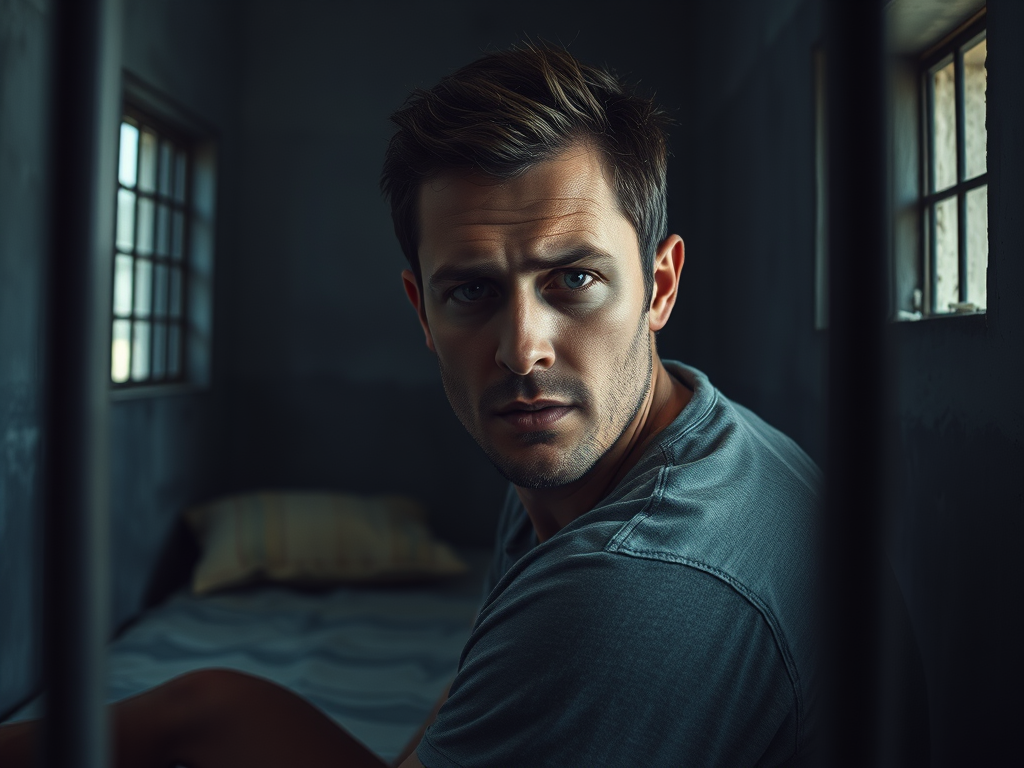
Months later, I found myself in Spring Hill Prison, held in a cell through the COVID lockdown. I was broken. The system, the police, and other forces were insisting I had done something I knew I hadn’t. It was as if reality itself had become disconnected. How can you know what is truth when everyone else is telling you you’re a liar?
I remember one night, in a different prison, doing what I knew other prisoners had done: the horrible cry of the night, covering my face with a pillow so nobody could hear me, so I wouldn’t be publicly shown to be weak. I cried into my pillow because it was all too complicated, simply too much. It felt like my whole world had collapsed.
It’s at this point, in the depths of despair, that you have to decide what you’re going to do: choose the road of courage or simply be broken and become an empty, hollow man.
What does it truly mean to choose courage in such circumstances? What is courage, really? My experience in prison forced me to grapple with these questions in a very real and immediate way. But the struggle to define courage is not new. Throughout history, philosophers and theologians have wrestled with this concept, offering a variety of perspectives on what it means to be courageous. In the following section, I want to explore some of these perspectives, drawing on figures like Aristotle, Søren Kierkegaard, and the ancient Hebrew scriptures to gain a deeper understanding of this essential human virtue.
What Do We Mean When We Say “Courage”?
Courage is one of those virtues everyone praises and almost no one defines. We invoke it for soldiers and whistle-blowers, for artists who risk obscurity, for people who speak when silence would be safer. Sometimes courage means defiance; sometimes restraint. Sometimes it is loud; sometimes almost invisible. The word carries moral authority, yet its meaning remains strangely unstable.
Philosophers have never agreed on it. Nietzsche understood courage as self-overcoming: the strength to affirm life without illusions, even at the cost of isolation. Schopenhauer, far darker, saw courage as lucid endurance—the honesty to live without consolation in a world structured by suffering. Karl Barth rejected human heroics altogether, locating courage not in inner resolve but in obedience to a divine summons. Dietrich Bonhoeffer, writing under tyranny, gave courage its most dangerous form: the willingness to act responsibly when moral purity is no longer possible, accepting guilt for the sake of others.
Against these dramatic visions, Aristotle’s account appears almost modest—and yet it may be the most demanding.
Aristotle Revisited: Cowardice and Rashness Today
For Aristotle, courage (andreia) is not fearlessness, bravado, or spectacle. It is a virtue of measure, a stable disposition to fear and face danger as reason dictates, for the sake of what is noble (to kalon). Courage stands between two failures: cowardice, where fear overwhelms judgment and action collapses, and rashness, where fear is denied and recklessness takes its place.
These failures remain with us today, though they often wear modern disguises. Cowardice appears as silence framed as prudence, responsibility endlessly deferred, moral minimalism that avoids blame rather than seeks the good, or quiet preservation of comfort and belonging. Rashness, by contrast, is frequently applauded: performative outrage, impulsive speech mistaken for honesty, moral absolutism that refuses complexity, or heroic posturing that assumes consequences will fall elsewhere. One flees; the other postures. Neither is courageous.
For Aristotle, true courage requires judgment (phronesis). It is neither silence nor noise, neither collapse nor excess, but the disciplined willingness to act at the right time, in the right way, for the right reason—when the cost is real.
Kierkegaard: Courage as Inward Risk
Aristotle assumes a world in which reason can discern the noble with some clarity. Modern life often feels less obliging. This is where Søren Kierkegaard presses courage inward.
Kierkegaard defines courage not by certainty, but by risk borne without guarantees. As he famously puts it:
“To dare is to lose one’s footing momentarily. Not to dare is to lose oneself.” — Søren Kierkegaard
What is at stake here is not recklessness, but identity. Cowardice, for Kierkegaard, is not merely fear of harm; it is the gradual erosion of the self through avoidance. Courage is the willingness to act while standing over uncertainty—to risk disorientation rather than self-betrayal. One may stumble by daring; one disappears by refusing to do so.

This deepens Aristotle rather than contradicting him. Courage is still measured, still opposed to rashness—but now the danger is no longer only physical or social. The danger is existential: the loss of oneself through perpetual retreat.
Joshua 1:9 — Courage Secured Amid Chaos
At this point, an ancient biblical command begins to sound unexpectedly modern. In Joshua 1:9, God commands Joshua to “be strong and courageous.” The Hebrew word used here is ’amats (אָמַץ), a term that does not describe emotional confidence or the absence of fear. Its core meaning is concrete: to be strong, to harden resolve, to gather strength so it does not scatter under pressure. Often paired with chazaq (“be strong”), it evokes disciplined strength brought to bear amid chaos, then directed toward a fixed purpose.
Courage here is not raw force, but force bound and directed—not the release of power, but its discipline. It is a vivid mirror of Aristotle’s measure, Kierkegaard’s existential risk, and the modern sense of heart (cor): the capacity to stand when every impulse tells you to flee.
Across Time and Thought
Across philosophy and scripture alike, courage keeps returning to the same pressure point: strength that neither collapses nor explodes, resolve that stands within fear without being ruled by it, a heart that does not scatter when reason—or responsibility—says, stand.
Given my experience—the disorientation, the brokenness, the years since 2019—this is something of what courage means to me:
Firstly, courage is lived out. It is reality embraced. It cannot and will not stand on fiction, fantasy, or illusions. Courage means facing reality in its rawness, in its horror, in all the hell that rains down upon oneself. It is not complete mastery of chaos, but embracing that chaos as best one can.
Secondly, courage accepts that fear is real. Emotional and psychological uncertainty cannot simply be overcome. Courage stands before fear. One of my worst fears was being overwhelmed by depression, anxiety, and my autistic traits, to the point it would cost me my life. I remember creating my will before prison, giving it to my brother-in-law, fully aware of that fear. Voices of false hope—“If God is for you…”—added further uncertainty in the face of reality.
Thirdly, courage demands bearing the cost. To resist, to hold your ground amidst uncertainties and pressures, requires accepting consequences. To not buckle, to hold your resolve, means standing apart, even when those around you assert that you are an outlier or unworthy. There is always a burden that must be carried. My body bears the scars of this stress, including functional neurological disorders. Courage embraces this cost.
Fourthly, courage is not always known in the moment. During incarceration, what I perceived was hurt, abandonment, and isolation. But courage is often revealed in reflection, when time allows us to see the strength we held.
Fifthly, hope is fundamental to courage. It may be the hope of remaining loyal to yourself, staying true to your being. Hope is as essential to courage as breathing is to living. Sometimes it is simply the hope to die well, or to endure with integrity.
Sixthly, courage sustains and endures. It rediscovers itself when consistency falters. Like Schopenhauer’s will, it is a driving force from deep within. It remains indefinable until experienced, unlivable until faced, and only fully revealed when life forces you to embody it.
There were times during incarceration, in the quiet solitude of my cell, when psychologists and others urged me to buckle, and I felt like collapsing. Yet in reflection, in moments before God and my own sense of integrity, I could rebuild something of the chipped foundation that the system sought to destroy.
Conclusion
Courage is elusive—not easily grasped or applied. It is a force that resists the storms of reality and recreates itself when reduced to a shadow. It is personal, linked to ethics, character, and hope.

My circumstances have given me a sense of strength in myself, and a corresponding distrust in the crowd or superficiality. I would rather stand on something real, even if hard, than in illusions that collapse, taking my sense of self with them.
So, don’t be hard on yourself when the world feels unstable, when the ground beneath you seems to shift. That is not a failure of character or being—it is simply standing in the reality of life. Courage, ultimately, is the ability to remain resilient no matter what life throws at you: to stand when you want to hide, to hold your ground when every impulse urges you to run. That is the ground of courage.




Leave a Reply