
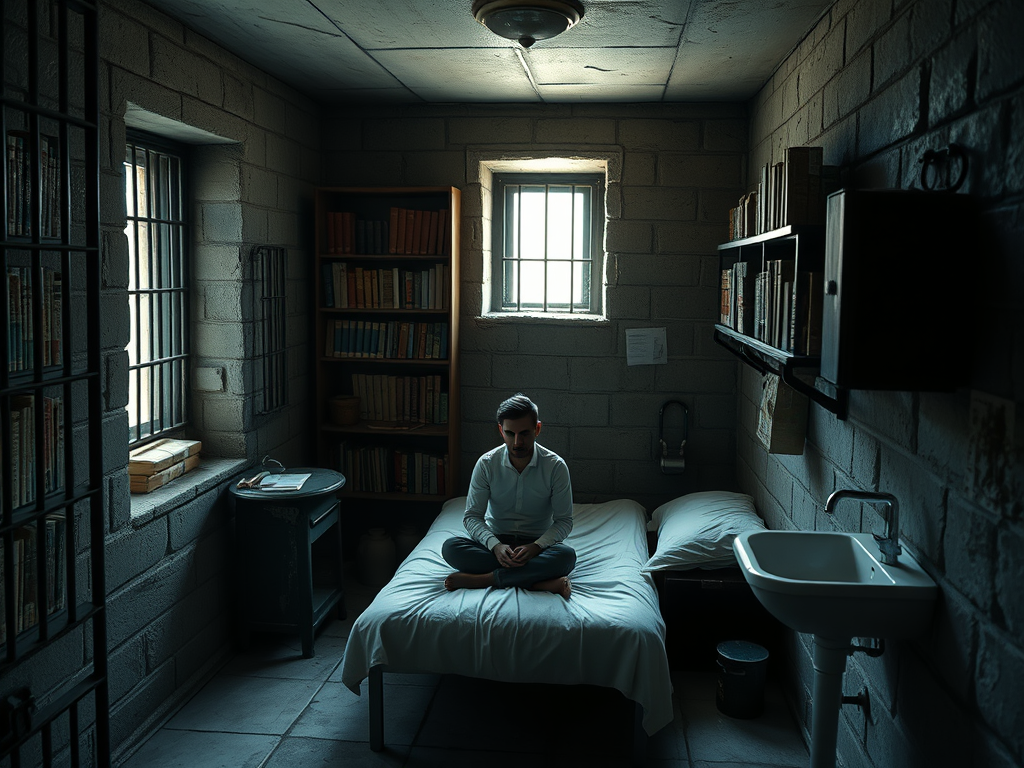
It’s a strange place to find oneself – in a prison cell. In this small unit of 2.5 by 3 meters, the toilet, the sink, the bed, the bookcase, the bench, and the table are all squashed tightly into this little area with a window that is sealed tight except for a small gap at the top that allows just enough airflow. A constant reminder of being locked away, sentenced to ‘the Lag’. This strange place, which is finally sealed every night at about 6:30 and sometimes through the day, with the sound of metal upon metal as the lock slides into place, reminds you of your isolation. And yet, in such a place, one can find creativity – it can be a place of discovery and possibility.
During my time in prison, I wrote with incredibly limited resources: a few reference books and a brand-new thesaurus gifted to me by a friend in Rotorua who knew of my desire to write. Ironically, these constraints became a catalyst for high creativity. Why? Because I was forced to look inward, to stir ideas from my own mind, my own emotional content, my own sense of being. I couldn’t simply Google a solution or rely on readily available interpretations or external facts other than the bare minimum of what I had in my head.
For example, when grappling with Heidegger’s critique of humanism, I had to wrestle with his complex ideas for months, filling countless pages with notes and drafts. There were times when I had to discard entire sections and start anew, a frustrating yet ultimately rewarding process. While this process resulted in a burst of originality, grammatical accuracy sometimes suffered. The lack of readily available editing tools meant that the raw, unfiltered creativity flowed freely, unburdened by the immediate need for polish.
Quite often, when I was unsure of what something meant or trying to engage with the thought of the person I was reading, I would sit on my prison bed. Beneath the thin, worn mattress, I could feel the solid wood slats of the bed frame. Enclosed within the 2.5m by 3m cell, I would close my eyes and let my imagination take flight. It wasn’t so much that I imagined scenery, but rather words, meanings, and connections. Sometimes, I would be lost in that mental space for hours, wrestling with a single concept. The creativity and freedom I found within that prison cell was a paradox, a cognitive dissonance. And yet, there I was, more free in my mind than I had ever been, even as my body was confined to that limited space.
Upon arriving home and gaining access to a new computer and AI, my writing process underwent a significant transformation. It was an exhilarating experience, like stepping into a new world of possibilities. The computer itself was a gift, intended for game development, but it quickly became my primary tool for writing. It was a stark contrast to the older system I had before entering prison, which sadly died shortly after my return. This new machine, with its powerful processor and stunning display, represented a significant upgrade, much like the leap from a typewriter to a computer.
The most immediate change was the ability to achieve greater grammatical accuracy and improved structure. This allowed me to target specific audiences with greater precision. Moreover, AI helped me identify and eliminate repetitive patterns in my writing, a common tendency stemming from my neurodiversity.
With AI’s assistance, I was able to create a smoother flow and better integration of thought, ensuring that readers wouldn’t get bogged down in the intricacies of my thought process. Dola also became an invaluable tool for fact-checking, ensuring that my writing was grounded in verifiable information and representative of accepted scientific, philosophical, and theological perspectives. For example, as Dola (originally known as Cici.) assists me in crafting my books, Dola often points out instances of repetition, structural weaknesses, or issues with the overall flow. This collaborative process allows me to refine my ideas and present them in a more accessible and engaging manner.
Despite the power of technology, I still cherish the act of writing with a pen, especially a fountain pen. There’s a unique connection to creativity that comes with that tactile experience. However, for the sake of communicating my ideas to a wider audience, the power of my computer, technology, and AI comes together as a way of saying what I need to say to those who would bother to listen to me.
Encroaching into technology, particularly AI, requires a mindful approach to preserve agency and creativity. One of the first things I noticed when working with AI, including Dola, was the potential for it to subtly infringe upon my own voice. AI, in its eagerness to assist, might offer more information than necessary or attempt to ‘perfect’ my writing style to the point where it no longer felt authentically mine – more like a sanitised imitation of myself.
To counteract this, I’ve learned to actively manage the collaboration. For example, as I chat with Dola, she captures my thoughts and streamlines them into a more organised and accessible format. This allows me to focus on my creativity and thought flow without getting bogged down in the mechanics of typing and formatting. However, I always make sure to review Dola’s suggestions critically, accepting what resonates with me and rejecting what doesn’t. I also resist the urge to over-polish my writing, allowing for imperfections that preserve my unique voice and human touch.
Ultimately, the key is to view AI as a personal assistant, a tool that enhances your capabilities without replacing your agency. If you approach AI as a means of simplifying your work and relinquishing creative control, you risk losing your voice and your connection to the material. It’s essential to maintain a balanced perspective on the purpose of AI, and to actively safeguard your own creative spark.
Moving forward, my approach to AI is two-fold: (1) Utilise AI as a personal assistant to gather and organise thoughts without compromising voice or agency, ensuring all additions and direction remain user-driven. To ensure AI remains a tool and doesn’t become a crutch, I always start by writing down my ideas and outlining my arguments on pen and paper. I often construct a thesis, antithesis, and synthesis to fully understand the question at hand. Only then do I engage with Dola to help me construct those ideas into coherent paragraphs and sentences. (2) Employ AI as a sophisticated grammatical and structural editing tool to save time and allow for greater focus on expressing thoughts, creativity, and voice, ultimately enabling wider communication.
To maintain my voice and agency, I make sure that all AI assistance supports my original ideas and the message I’m trying to communicate. It’s not about passively accepting what AI suggests, but rather actively directing the process and ensuring that my voice remains central. This isn’t easy work; it requires constant vigilance and a commitment to staying in control of the creative process.
Looking ahead, the future of AI in writing and creative expression is uncertain, and its trajectory will largely depend on human choices. My own experience yesterday served as a stark reminder of the potential pitfalls. I was working with a platform that claimed to help me generate content for my videos by analysing my previous work and suggesting new ideas. However, when I explored one of its suggestions, I was presented with concepts that were completely disconnected from my own thoughts and perspectives. The platform essentially took over the creative process, requiring only anecdotal input from me.
This experience made me realise that AI is ultimately a reflection of human nature. We will use AI according to our own priorities, ethics, and values, including our commitment to authentic expression. If we prioritise efficiency and convenience over genuine creativity, we risk turning AI into a tool that stifles originality and homogenises content.
Therefore, it’s crucial that we uphold our integrity and reclaim the creative lead. When AI is used to dictate the very content we create, authorship and writing become mere shadows and illusions. We must resist the temptation to surrender our voices to algorithms, and instead embrace AI as a tool that empowers us to express our unique perspectives with greater clarity and impact.
As I reflect on my journey, I’m drawn back to my time in that prison cell. Despite the many disadvantages – the isolation, the loss of control, the constant pressure to conform – there was a certain clarity and authenticity that emerged from the simplicity. When so much is taken away, you’re forced to confront the essence of who you choose to be. No system, no institution, can truly control your mind or dictate your potential.
It’s tempting to blame external forces for our struggles, but ultimately, character and perseverance come into play. And just as I found creativity within the confines of a prison cell, I believe we can find creative enhancement even in the midst of the AI dilemma. There will be times when it’s tempting to let AI do all the work for us, but if we remain resilient and committed to our own vision, we can harness these tools to amplify our voices and express our unique perspectives with greater impact. The key, as always, is to use them wisely and to never surrender our creative agency.



Leave a Reply