
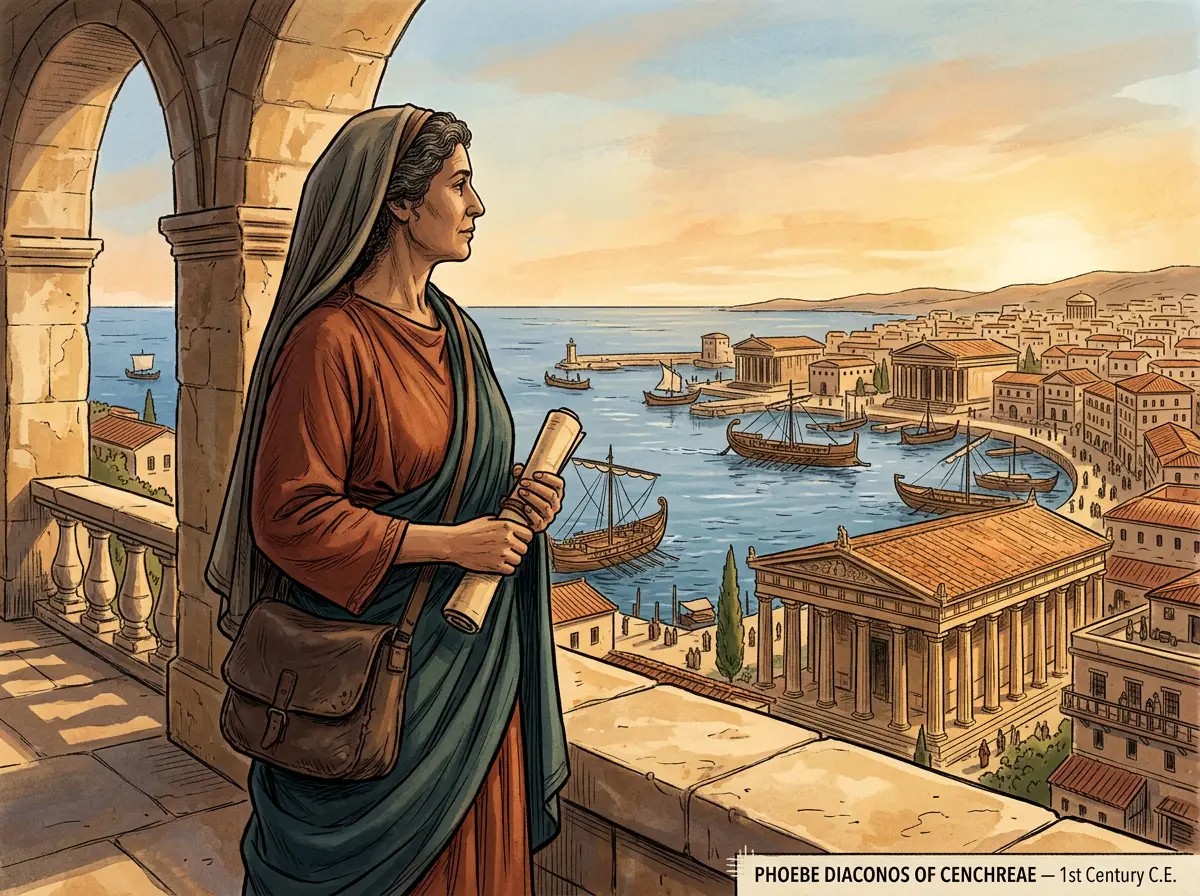
Phoebe, Romans 16:1–2, and Women in Ministry
Short answer: Phoebe was a minister, patron, and the first authorised expositor of Paul’s letter to the Romans — one of the most significant women in early Christian leadership, and clear evidence that women held public, recognised, and authoritative roles in the first-century church. Restrictions on women in ministry came later, from cultural accommodation, not from Scripture or the example of Paul.

The Text (Romans 16:1–2 ESV):
“I commend to you our sister Phoebe, a servant of the church at Cenchreae, that you may welcome her in the Lord in a way worthy of the saints, and help her in whatever she may need from you, for she has been a patron of many and of myself as well.”
Two Key Greek Words Tell the Story:
- “Servant” — diakonos: Not a lowly helper — this is the word Paul uses for his own ministry and that of Apollos and others. It means an active, recognised minister or deacon. She held official leadership status in the church at Cenchreae.
- “Patron” — prostatis: A defender, protector, benefactor, and leader. In the Greco-Roman world, this was a person of means and social standing who provided financial, legal, and social support to communities. Paul explicitly says she supported him and many others — a remarkable admission from an apostle who usually refused financial aid.
Her Role: Most Scholars Agree She Carried the Letter to Rome
In the ancient world, the person who delivered a letter also read it aloud, explained it, and represented the author. Paul is essentially saying: “Listen to her — she speaks with my full authority.” What is very important here is that this woman is the first teacher to explain the letter to the Roman church — authoritatively and theologically.
N.T. Wright’s Perspective:
Wright emphasises that Phoebe is no footnote — she is the most important person in Romans 16, and her role directly challenges later restrictions on women. She was a minister, a patron, a letter-carrier, and Paul’s authorised representative. There is no hint of subordination; she is a trusted colleague and leader.
Implications for Women in Ministry:
- She held recognised, public leadership roles (diakonos, prostatis)
- She was entrusted with apostolic authority as the bearer and interpreter of Scripture
- She financially and practically supported Paul’s mission — a partner, not just a follower
- There is no biblical text restricting women from serving as she served
The Cultural Shift — A Critical Observation:

As true to the early church, what started as a radical new creation move was hijacked by culture and the gravity of the crowd. Over time, the church gradually accommodated to surrounding Greco-Roman social norms, and the open, Spirit-empowered equality of the first generation was slowly restricted. The restrictions we see today come from that later cultural compromise — not from the text itself.
Bottom Line:
Phoebe wasn’t an exception — she was an example. The early church saw women leading, teaching, supporting, and carrying the gospel, and Paul honoured it. Restrictions on women in ministry come from later tradition, not from the text or the example of Paul. We do well to ask: are we reading Scripture on its own terms — or are we reading it through the lens of the very cultural biases the gospel came to overturn?




Leave a Reply