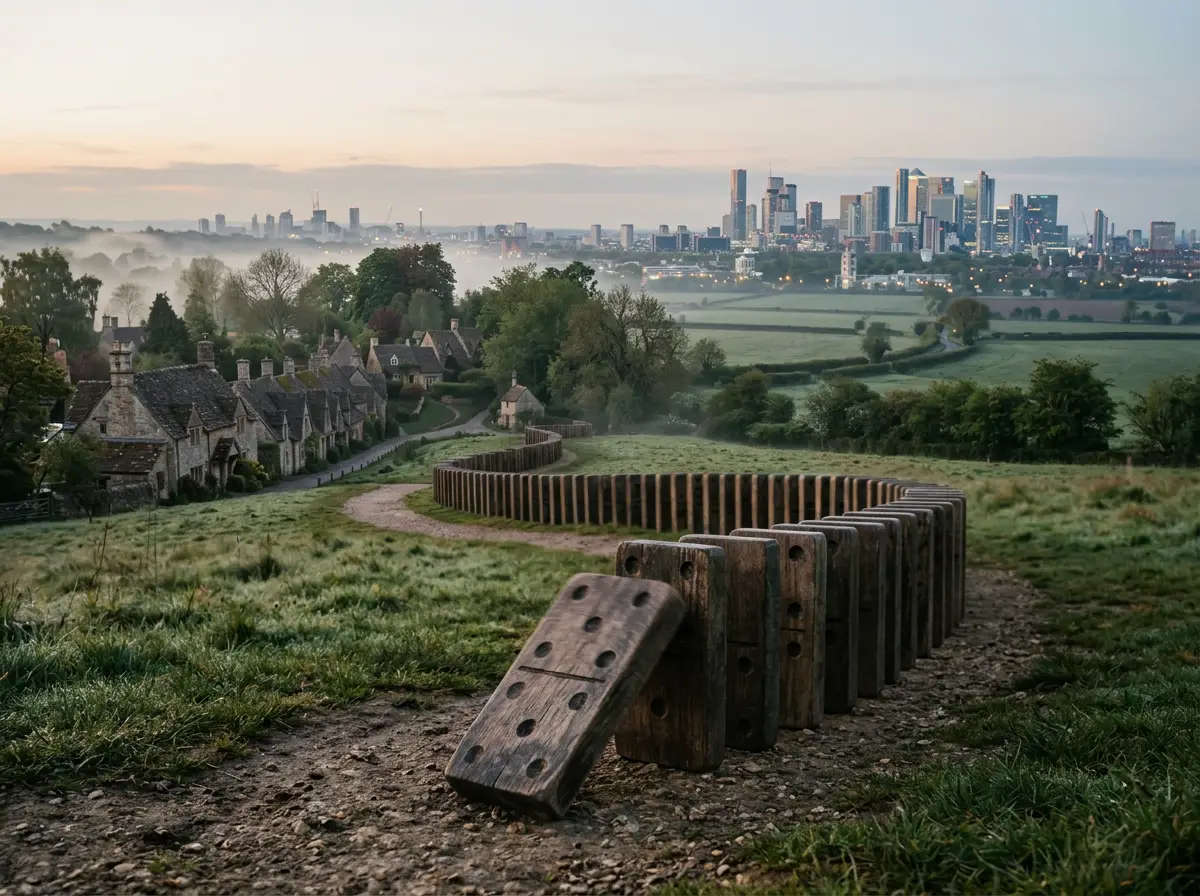
It is easy to imagine we can live as though our actions carry little weight — as though what we do and say barely matters. But the truth is: we live in a world of consequences, much like dominoes subject to gravity. Sooner or later, the choices we have made — and even the choices we have failed to make — will shape our lives. Some impacts will be barely noticeable; others will alter everything forever.
There is another reality we must accept: we live in a web. We are like nodes in a vast spider’s web, each connected to the next. The closer we are to someone, the more their decisions affect us — and ours, them. We are profoundly vulnerable to one another’s choices, for better or worse. Where do you feel those connections most strongly in your own life?

I have often pondered how our decisions — both the ones we actively choose and the ones that simply happen to us — ripple outward. They shape us, those around us, and even the world we inhabit: the very ground we stand upon, and the unseen realities beneath it.
From a Christian perspective, we are sometimes offered what I can only call cheap grace: the promise of easy forgiveness, instant healing, and complete release from the consequences of past choices. Such rhetoric is ill-founded. It is dangerous to teach from the pulpit. It ignores the very nature of reality God Himself established. Have you ever encountered that kind of teaching, and how did it leave you feeling?
This is precisely what the writer to the Hebrews wanted his readers to understand. He wanted them to think carefully about their choices — how they live with one another, how they grow in faith, and how they become the people God created them to be.
Right after the great chapter of faith, the author turns immediately to the therefore — showing what faith looks like when lived out on earth. He encourages them: Lift up your drooping hands. Strengthen your weak knees. Make straight paths for your feet — so that you may know how to walk well. And he adds this hope: that through making good choices, you may be healed.
It is in this context that he speaks of Esau.
One meal. One moment of hunger. One desire given way to, without thought for what was being traded. One choice, and he gave up his birthright for a single bowl of stew.
It is exactly here that we read these sobering words:
“For you know that afterward, when he desired to inherit the blessing, he was rejected, for he found no chance to repent, though he sought it with tears.”
— Hebrews 12:17 (ESV)

The Scripture is surrounded by verbs — actions that call us to stand maturely in reality, capable of navigating the difficulties of life. And yet Esau — a man with the same hunger, the same passion, the same human desires as any of us — took his privilege for granted. He traded his birthright for something that satisfied his stomach for a moment.
Is this not the human condition? Who among us is not driven by appetite, by need, by longing? Passion and desire are not evil in themselves. They are part of being alive. But their object, their focus, what they are set upon — that determines everything.
Understanding “Repentance” in Context
Before we move further into Esau’s story, it’s crucial to pause and consider the word often translated as “repent” in this passage: μετάνοια (metanoia).
Our common understanding of “repentance” can sometimes feel like mere sorrow, regret, or emotional anguish. We might think of Esau weeping with tears and assume that’s the essence of it. But the original Greek offers a deeper, more functional meaning — especially when paired with the phrase topon metanoias — “no place for metanoia.”
The word metanoia itself is a combination of meta- (meaning “after” or “change”) and nous (meaning “mind” or “understanding”). So, etymologically, metanoia is fundamentally “a change of mind,” “a change of thinking,” or “a change of purpose.” It is not primarily about feeling bad, but about a decisive shift in one’s perspective, values, and will.
When the writer to the Hebrews says Esau found “no place for metanoia,” it suggests he found no available recourse, no pathway, no opportunity for this change of mind to be effective or to alter his situation. His tears were for the lost blessing, not for the act that forfeited it, and there was no longer a functional “place” where a change of mind could undo the irreversible transaction.
This distinction is vital. It means that while Esau experienced deep regret and sorrow, he did not experience the fundamental reorientation of mind and will that true metanoia signifies. His desire was to inherit the blessing — but the pathway to achieve that through a changed mind and a corrected course was closed off by his own decisive action.
It prompts us to ask: has our modern understanding of “repentance” become so diluted that it has lost this powerful sense of a decisive change of mind and will? Has it become so associated with mere emotion that we miss the functional reality of what it means to truly turn, to find a new direction, and to seek a pathway that God’s grace makes available?
The Impossibility of Returning to the Start
This idea — that we cannot simply go back and erase our choices, that there is an impossibility in returning to a beginning stage to “recast” what we wish we could have done differently — is something I have carried with me for decades. It is a reflection that has stayed with me since my thirties, and it speaks directly to this very issue: the nature of culture, societies, and our collective human state within our nations. Let me explain what I mean.
We live in a world where actions create ripples, where decisions — once made — set in motion a chain of events that cannot be simply unwound. Think of it like a vast, intricate web, where each of us is a node connected to countless others. The closer we are, the more profoundly their choices impact us, and ours, them. This interplay of passive and active decisions affects us, those around us, and even the physical world we inhabit. Where do you feel those connections most strongly in your own life?
And this is true not just for individuals, but for societies and cultures. Nations, over time, build up layers of history — of decisions made, of paths taken. We cannot simply wish away the consequences of a nation’s past actions — its triumphs, its injustices, its foundational choices. These become woven into the very fabric of its being, shaping its present and its future.
We cannot undo the past. We cannot reset the clock on a society’s trajectory. The choices made by previous generations, the foundations laid, the systems established — these continue to exert influence, shaping the landscape upon which we stand today.

Consider this illustration: Imagine a village, a thousand years ago, anywhere on earth. A missionary arrives, is welcomed, and works there — gaining trust and sharing his faith. Over time, however, some in the tribe — perhaps clinging to the past or fearing change — begin to isolate those who have accepted the message. An uprising follows. The missionaries are killed. Those who embraced the faith are either killed or flee.
Years pass. The village turns on itself. Many are slaughtered. Eventually, after a few generations, there are no Christians left. Only echoes remain — distorted narratives of how “evil” missionaries corrupted their culture and religion. Now, fast forward. Consider that pathway for a hundred years, two hundred years, or even five hundred years. The decision made back then — that decision to stand against faith, to stand against the missionaries — may have had a far deeper, more devastating impact than we are willing to admit.
And then, we might argue about why people who do not believe end up being judged by God — without understanding the connection to decisions made generations before. No one stands in a vacuum. The relationship we have with our future children and grandchildren is the same kind of historical effect that those who came before have had on us. There needs to be much more care and understanding about the source of problems.
The Political Merry-Go-Round
This same pattern of intergenerational consequence, this inescapable web, plays out not just in villages or personal histories, but in the grander theatre of sociology and politics. Consider the often-absurd cycles we see in how societies manage themselves. Do you ever feel that same sense of being stuck, going round and round?
We swing from the right wing to the left wing, and back again — often forgetting with alarming speed how both extremes — and indeed, any extreme — can create complex problems and undermine human well-being and flourishing. It seems almost absurd: one day, we might vote for a Labour government (left-wing leaning); three to six years later, we are voting for a National government (right-wing leaning). We are swayed by emotional narratives and rhetoric, shifting our direction without truly learning from the past.
This same short-sightedness leads societies to create instability. We do not advance. We simply go round and round the same bush. Until, eventually, the whole society digs itself into a collective trench — locked in and stuck, unable to move forward.
The Human Brain and the Lure of Shortcuts
Let me put this in another way. Consider the very design of our brains. They are wired to find simple solutions to complex problems — to seek shortcuts that allow us to make decisions quickly, based on our observations and past experiences. This might work perfectly if we were computers, or if we could somehow eliminate our emotional expectations, our desires, and our fears.
But we are not computers. We are human. And so, when we face decisions, when we are called to make choices, we tend to seek the shortcuts in life. These shortcuts, however, can often lead us down a path of isolation. Those very desires, those passions, those hunger pangs can become so central to all that we do. The desire to get from point A to point B as simply and as comfortably as possible may well end up being the very thing that leads us to:
- The loss of our birthright,
- The loss of a flourishing good life,
- The loss of love and relationships,
- The loss of well-being, health, and fitness,
- And most certainly, a loss of spiritual connection to God, and to the very people we love around us.
This is the immense risk we take when we fail to understand just how simple it can be to make wrong choices — and then to be left with their profound and lasting consequences.
The True Cost of Our Choices
So, where does this leave us? We have explored the inescapable world of consequences, the intricate web of our connections, the echoes of past decisions through generations, the cycles of political folly, and the very wiring of our brains that tempts us toward shortcuts.
And in this context, we must revisit that word: “repentance.” Instead of seeing it solely as the traditional interpretation of sorrow or regret, perhaps we can look to the meanings we have uncovered: recourse, recasting, or a fundamental change of mind.
Let us be clear: there is no going back to erase the choices we have made. We cannot simply “take recourse” or “recast” our past actions as if they never happened. Grace does not logically erase the decisions made and their consequences upon us.
Rather, grace allows us to choose differently now. It empowers us to move in a new way with God, towards better outcomes. But here is the solemn, uncomfortably true reality: grace does not negate the cost of our choices.

It is far better to work these things out when we are young — when the mistakes we make are less severe — than to face these decisions when we are older and the opportunities for new ways of living are diminishing. The reality of it all, seen not just in Esau but in many biblical characters like Samson, who also made his choices under the sway of arrogance, passions, and desires, is this: when we allow these impulses to interrupt that which would bring us flourishing and healthy living, it will cost us. And it will always cost us.
That does not mean grace has no value. Far from it. But it does mean that decisions are real. And for that reason alone, we must think solemnly and carefully about the days we live in, and the choices we make today.



Leave a Reply