
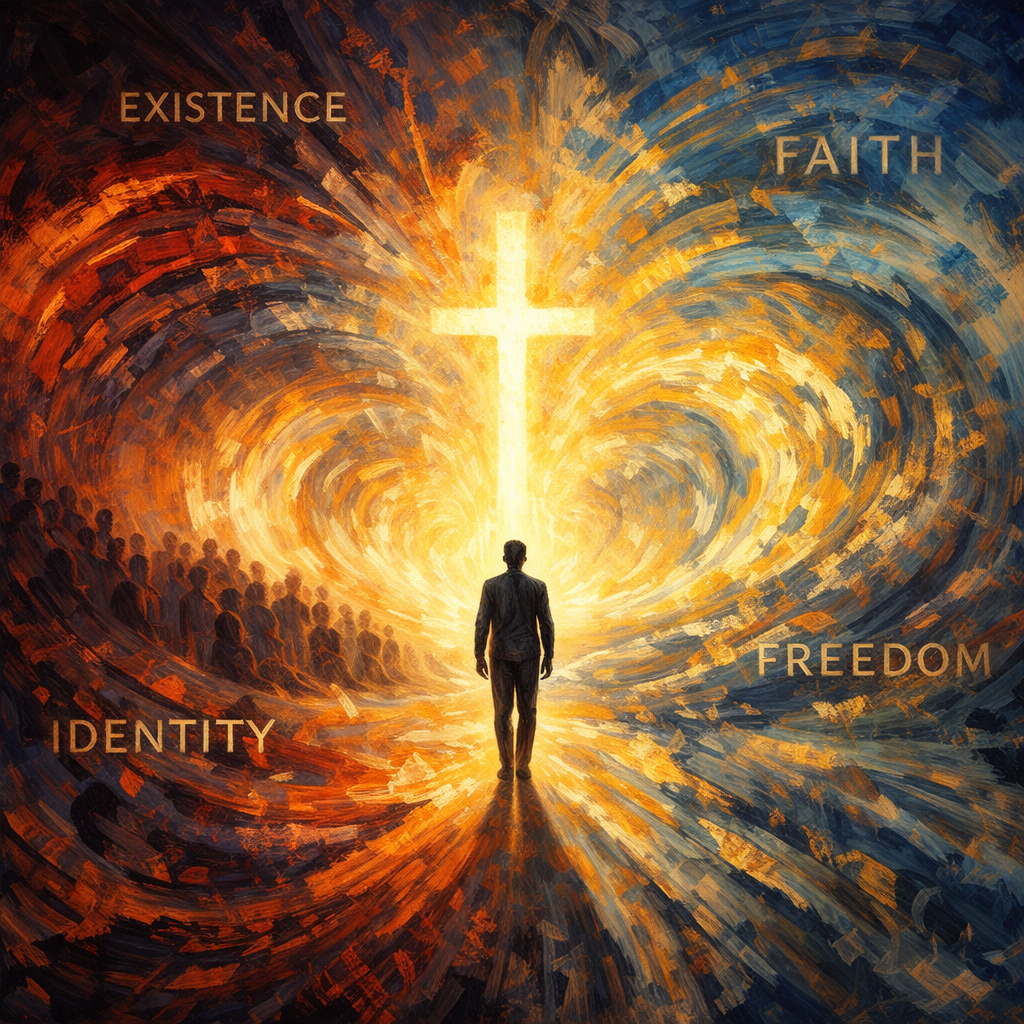

Paul’s words are uncomfortably direct:
“For freedom Christ has set us free; stand firm therefore, and do not submit again to a yoke of slavery”
(Galatians 5:1, ESV)
That phrase matters: again. Paul is not simply talking about bad theology in the abstract. He is talking about a return, a regression, a movement back into bondage. To insist on circumcision and the law as grounds of justification is not an innocent addition to Christ. It is a turning away from Christ.
Paul goes on:
“Look: I, Paul, say to you that if you accept circumcision, Christ will be of no advantage to you… You are severed from Christ, you who would be justified by the law; you have fallen away from grace”
(Galatians 5:2, 4, ESV)
This is strong language because the issue is not minor. To rebuild identity around law, performance, and visible belonging is to step away from the Cross itself. It is to reject the sufficiency of grace and to place one’s confidence in something else. It is, in effect, to demote Christ.
And once Christ is demoted, other authorities rush in to fill the vacuum. Human systems. Group loyalties. theological badges. Performative piety. External compliance. The flesh is quite inventive when it comes to producing substitutes for grace.
Paul understands something about us that we often do not want to admit: once identity is located outside the grace of Christ, life begins to reorganize itself around performance, comparison, and exclusion. That is why the contrast later in Galatians 5 between the works of the flesh and the fruit of the Spirit is so important. These are not random moral lists. They are rival modes of existence.
The works of the flesh include things such as enmity, strife, jealousy, fits of anger, rivalries, dissensions, divisions, and envy. These are not accidental. They are what emerge when human beings seek validation through self-assertion, faction, and superiority. They are the social and spiritual fruits of misplaced identity. Once grace is displaced, the tribe begins its work.
By contrast, the fruit of the Spirit is love, joy, peace, patience, kindness, goodness, faithfulness, gentleness, and self-control. These are not merely virtues to admire. They are the organic outgrowth of a life rooted in Christ rather than the crowd. Where grace governs identity, human life begins to heal.
That is the real conflict in Galatians 5. It is not simply law versus no law. It is slavery versus freedom. Performance versus grace. faction versus love. The old human arrangement versus the new creation.
The Temptation of the Tribe
It is one of the more depressing regularities of human life: put enough people together, leave them alone long enough, and they will begin to divide. It can happen in churches, families, institutions, political movements, online subcultures, and prayer groups. It rarely takes very long. One faction forms, then another. Distinctions sharpen. Loyalties develop. Language shifts. Tension rises. Someone becomes suspect. Someone must be challenged. Someone becomes useful as a warning to the rest.
This tendency is so common that we almost mistake it for normality. In one sense, it is normal, but only in the sense that the Fall is normal to us.
William Golding captured this with disturbing clarity in Lord of the Flies. What begins as a group of boys stranded on an island gradually descends into faction, power struggle, fear, and violence. The point is not that children are unusually savage. The point is that beneath the thin varnish of social order lies something unstable in us. Group identity does not merely gather people together; it can deform them. Innocence quickly becomes political. Belonging becomes a contest. The crowd creates its own morality.
This same logic appears in more respectable forms all the time. The tribe does not need spears and painted faces. It can wear theological precision, moral seriousness, political urgency, or ecclesial orderliness. It can sing hymns. It can quote Greek. It can run committees. It can smile while quietly deciding who is in and who is out.
That is why tribalism is not merely a cultural problem “out there.” It is not the sin of other people. It is a perennial human temptation. I have seen it in others, yes, but also in myself.
When I was younger and deeply immersed in my early denomination, I genuinely believed God had raised us up in a special way. At the time, this felt like conviction. Looking back, it was also arrogance. I judged others for not belonging to our tribe. I assumed we saw more clearly, understood more purely, and occupied a more faithful place before God. It disgusts me now. Not because I no longer believe truth matters, but because I can see how easily truth claims become tools of self-exaltation when they are absorbed into tribal identity.
This is the real danger: even good things can be conscripted by the flesh. Doctrine can be used as a badge. Spiritual experience can become status. Conviction can curdle into superiority. Fidelity can be twisted into theatre.
The tribe is never content merely to belong. It wants to feel justified in belonging.
The Crowd and the Loss of the Person
Søren Kierkegaard’s statement that “the crowd is untruth” remains one of the most incisive observations ever made about human collectivism. He did not mean simply that crowds tell lies. The deeper point is that the crowd distorts responsibility. It dilutes personhood. It relieves the individual of the burden of standing truthfully before God.
One or two individuals can speak, reason, disagree, reflect, and remain recognizably human. But once the crowd forms, something changes. There is a shift in atmosphere, in pressure, in instinct. People begin to perform for belonging. Conscience bends. Language becomes strategic. Integrity becomes negotiable.

The crowd does not always demand open wickedness. Often it asks only for small compromises, tiny adjustments, slight silences. A softening here. A nod there. A refusal to say what one truly thinks. A willingness to let something slide because belonging feels safer than honesty. But these little compromises accumulate. Over time, the individual perspective is not merely hidden; it is sacrificed.
And because the human person longs to belong, this pressure is powerful. We want to sit among those who accept us. We want the warmth of shared approval. We do not want to become strange, difficult, or disposable. So we adjust ourselves. We begin speaking in ways that will keep us safe in the group. We become slightly less truthful in order to remain recognizably one of “us.”
That is often where the works of the flesh begin their quiet labour. Not in dramatic rebellion, but in fear. Fear of being othered by our own side. Fear of becoming suspect. Fear of not fitting the approved pattern. And once that fear takes hold, scapegoating is never far behind. Someone else must absorb the tension. Someone else must carry the unease. Someone else must become the problem so that the group can preserve its self-image.
I have lived through this as well. In one church, distinct factions emerged, each carrying its own spiritual vocabulary and political posture. When I expressed discomfort and said I needed time to work out where I stood, that hesitation became intolerable. For each group to appear faithful to its own representatives, I had to be challenged. In the end, I was attacked. It was not especially subtle either. The group needed to demonstrate its certainty, and I became useful material.
This is what the human beast does. It protects belonging by sacrificing honesty. It preserves the tribe by wounding the person.
The Incarnation and a Different Kind of Identity
If the story ended there, human life would be unbearably bleak. But the Christian faith does not merely diagnose the tribal instinct. It announces that something decisive has happened in Jesus Christ.
The doctrine of the Incarnation is not an ornament of theology. It is a revolution in the meaning of identity. God has not remained distant, issuing commands from beyond our condition. God has become human in Christ. He has entered the very world of division, violence, pride, and exclusion that we have made. He has stepped into our fractured humanity not to sanctify our tribes, but to redeem human beings.
This changes everything.
If Christ is the incarnate God, then our identity can no longer be secured by external markers, factional loyalties, or comparative righteousness. Our identity is not finally found in our denomination, social class, theological tribe, political instincts, or moral performance. It is found in relation to Him.
That is why Paul can say that neither circumcision nor uncircumcision counts for anything. The old markers have been relativized by Christ. They do not disappear as realities in the world, but they lose their power to define the human person before God. Grace has displaced them.

This is what makes Christian identity radically different from tribal identity. Tribal identity is secured through distinction. It needs boundaries, enemies, and visible signs of belonging. It feeds on contrast. But identity in Christ is received as gift. It is not earned. It is not displayed to secure status. It is not strengthened by pushing others down. It does not require the diminishment of another human being in order to feel stable.
This is a life of absolute value because it is grounded in the One who is absolute. Christ is the superlative One. He is not one loyalty among many, nor one tribal banner to be preferred over competing banners. He is Lord. When that becomes real to us, much of what once felt urgent begins to look strangely flimsy. The endless dramas of “us” and “them,” the brittle anxieties of belonging, the frantic effort to secure ourselves through visible identity, all of it begins to appear thin, futile, and faintly silly.
Not trivial, because the damage is real. But silly in the sense that we have treated these lesser things as though they could bear the weight of ultimate meaning. They cannot.
And this identity in Christ does not make us superior. Quite the opposite. It strips superiority of its theological alibi. To belong to Christ is not to become part of an elite spiritual caste. It is to live by grace. It is to stand as one who has received mercy, not as one who has achieved distinction. It is to understand, with increasing seriousness, that God shows no partiality.
The Father of the prodigal does not stand at the door waiting to congratulate the elder brother for tribal consistency. He waits for the lost. He runs toward the ruined. He receives the one who cannot save himself. If this is the shape of divine grace, then any Christian identity that feeds on exclusion has already betrayed its source.
Faith Working Through Love
Paul brings the matter into startling focus:
“For in Christ Jesus neither circumcision nor uncircumcision counts for anything, but only faith working through love”
(Galatians 5:6, ESV)
This verse is existential in the deepest sense. It does not ask merely what camp you belong to or what doctrinal badges you wear. It asks what is essential to your existence before God. Who are you, really, when the tribe is stripped away? Who are you when performance fails? Who are you when the crowd can no longer carry you?
The Christian answer is not found in self-construction, but in fidelity to Christ. Yet this fidelity is not inert. It works through love. That is Paul’s phrase, and it matters immensely. Faith is not a tribal label. It is not merely assent. It is not a password used to identify one’s group. Faith becomes visible as love.
This is where Christian freedom becomes demanding. Freedom in Christ is not freedom to retreat into private assurance while despising the world. Nor is it freedom to gather a purified camp of the correct. It is freedom to live in such a way that the life of Jesus takes visible form in us.

That requires both proaction and resistance.
We are proactive toward the good. We are called to embody the pattern of Christ, who did not remain aloof from a broken world but entered into its sorrow, its filth, its violence, and its grief in order to bring grace. He did not save from a distance. He stepped into the wound.
And we are resistant toward all that opposes grace. Not just obvious evil in the abstract, but every habit of soul that makes us less capable of seeing others through the eyes of Christ. We resist self-exaltation, factional pride, cruelty, contempt, and the subtle pleasure of having an enemy. We resist the instinct to negate others in order to secure ourselves.
This is where the Christian life becomes painfully personal. The issue is not simply whether I can identify the tribalism of others. The issue is whether I will allow Christ to expose it in me. Whether I will relinquish the identities that make me feel important. Whether I will surrender the small performances by which I reassure myself that I belong among the righteous.
Because ultimately, it is the individual who stands before God.
The Cost of Living Beyond the Tribe
To live this way is costly. It will make you strange.
The person who refuses the easy comfort of faction, who will not flatter the tribe, who insists on grace over performance, and who seeks to remain truthful before God rather than useful to the crowd, will often become an “Otherling.” Even sincere goodness can be interpreted as threat. People accustomed to tribal order do not always know what to do with a person who will not play the game. Your refusal to join the usual reciprocity of suspicion may be read as compromise. Your loyalty to Christ over group reflex may be treated as betrayal.
That cost must be embraced.
But there is also real hope here. Human transformation often happens through small, steady acts of fidelity. Resisting old patterns. Refusing contempt. Choosing honesty. Practising patience. Turning back again and again to grace. These small movements may not look impressive, but they accumulate. Righteousness has a kind of quiet domino effect. It alters the atmosphere where you stand. It does not fix the whole world at once, but it bears witness to another kingdom within it.
None of this happens without effort. The Christian life is not passive drift. It demands attention, repentance, endurance, and action. We must stop waiting for someone else to do the work of faithfulness on our behalf. We must stop outsourcing spiritual responsibility to tribes, systems, and approved representatives. There is something irreducibly personal here. To live a Christian life is to live a life of fidelity to Christ that no crowd can perform for you.
What other choice do we have?
Conclusion
The world will keep dividing itself. New tribes will emerge. Old tribes will harden. Human beings will continue trying to secure identity through belonging, comparison, and exclusion. The banners may change, but the impulse remains familiar.
But the gospel calls us beyond the tribe.
It calls us into a freedom that cannot be secured by performance and does not need the crowd to sustain it. It calls us into an identity rooted in the grace of Jesus Christ, the incarnate God who entered our broken condition not to intensify our divisions but to redeem us from them. It calls us into a life where faith works through love, where the fruit of the Spirit displaces the works of the flesh, and where the person begins to stand truthfully before God.
This is not tidy work. It is often messy, slow, and costly. It may strip away identities we have cherished. It may leave us exposed. It may make us look odd to those still nourished by faction and moral theatre. But it is the path of life.
To become more than tribal animals, we must aim higher than the average instincts of the herd. We must live toward the greater ideal revealed in Christ. And in doing so, however imperfectly, we begin to discover what freedom actually is: not the liberty to glorify our group, but the grace to become fully human in Him.
Media short talk on the above:




Leave a Reply