
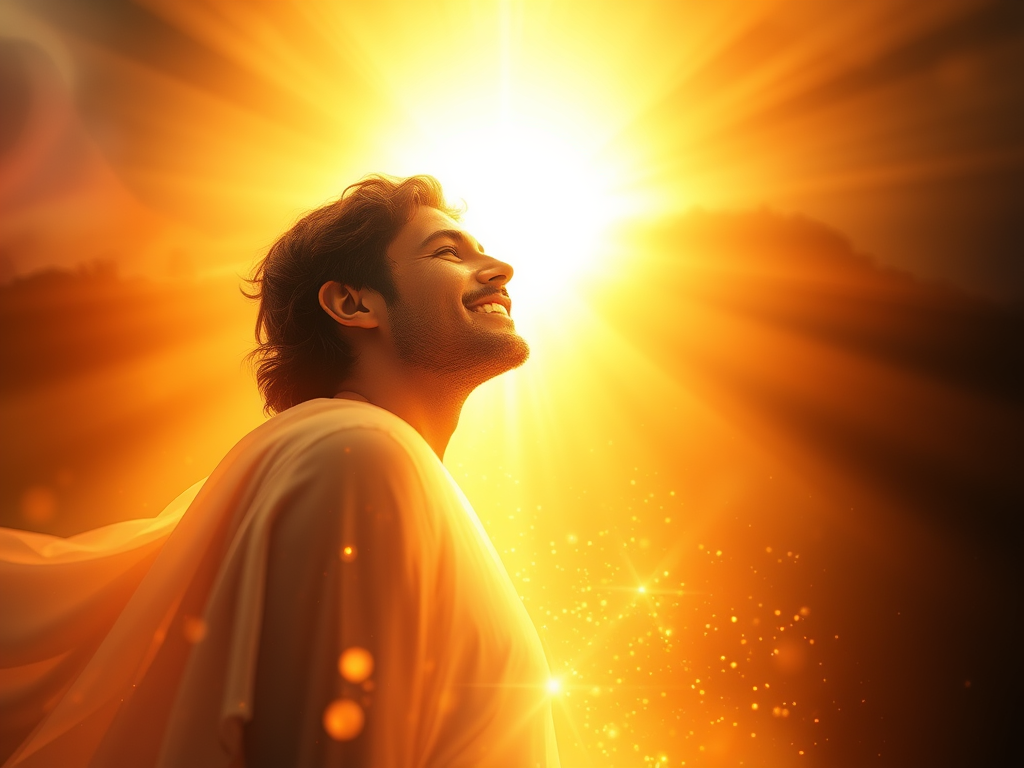
What happens, what arises within, when all is taken? Who is left standing and where is their fidality focused on?
Many years ago, when I was about nineteen or twenty, I was living on a farm. Night there was never silent, only layered. Sheep shifting in the dark. The occasional truck passing along the country road. The shearing shed and holding pens close enough that animal movement became part of the texture of sleep.

One night I went to bed as usual and fell into a deep sleep. I remember a sudden, sharp pain through my chest — precise and uncomfortable. Then something shifted.
My body, lying in the bed, seemed to look upward. I saw what I can only describe as a soulish version of myself looking back down.
From the bed, my body asked, “What’s it like to be free of me?”
The soulish self answered without hesitation, “Oh, it’s so good. It’s so great to be free at last.”
From the body’s perspective, things began to fade. The room dissolved. The farm dissolved. The familiar structure of the world thinned out. Then I became conscious only as that soulish self.
It was as though I were being lifted. As I rose, ordinary reality receded — the bedroom, the walls, the weight of the world. In its place came a sharp, intense, beautiful light. It did not merely shine; it enveloped. It was warm, brilliant, and full in a way that felt overwhelming yet completely natural.
I found myself standing — though how I knew I was standing I cannot explain — in the midst of this light. I could not see anyone, yet I sensed many others. Souls. Persons. A density of life beyond sight. And beyond even that, there was a Presence — immense, immeasurably greater than I could comprehend. The light surrounding me felt like only the smallest expression of a reality far beyond it.

The joy there was fluid and organic. Not excitement, but rightness. I felt more alive than I have ever felt in ordinary waking life. Gratitude began to rise within me, as though something in me were about to respond — to give thanks, to praise.
And then everything changed.
There was no gradual dimming. No slow descent. It was immediate, as if I had stumbled.
The field of light collapsed.
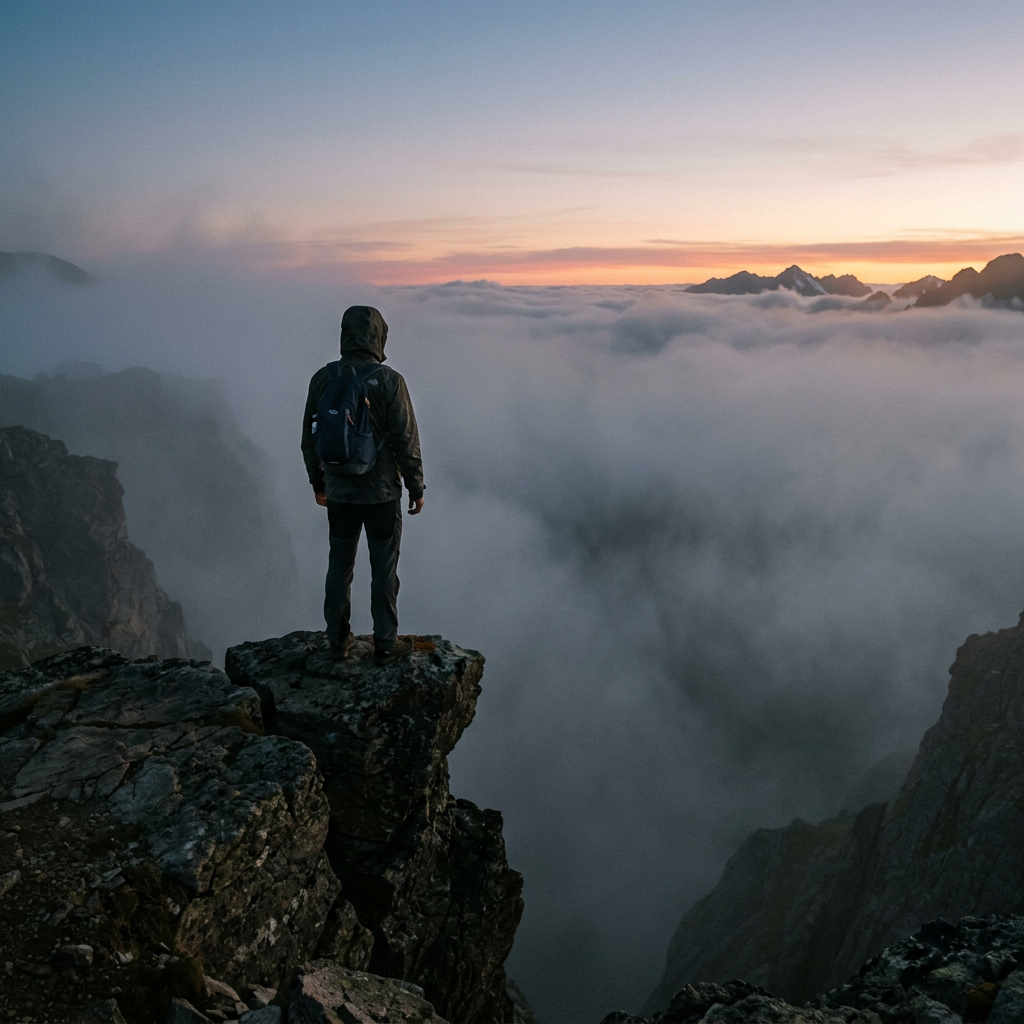
I found myself standing — again, the posture known rather than seen — in a reality that was the opposite of what had been. Darkness surrounded me. Not merely the absence of light, but something dense and heavy, like clothing wound tightly around the body. It pressed. It enclosed.

There was nothing to see. No horizon. No sky. No ground that could be meaningfully distinguished from anything else. It was as though all contrast had been erased. The space felt arid — lifeless, hostile, empty of relational presence.
What made it unbearable was not fear of pain. It was isolation. Even if I could shout, even if I could throw something beyond human strength, even if I could pierce the darkness — which felt impossible — there would be no echo. No response. Nothing but myself and this consuming density.
The gratitude that had been forming in the light was swallowed. In its place came disappointment, severance, abandonment. Sadness rose not as a passing feeling but as something catastrophic.
And yet something remained.
What arose in me was not anger at the darkness. It was not defiance against it. It was fidelity.
“If I cannot praise God in heaven,” I said within myself, “then I will praise Him in hell.”
It was not dramatic. It was not loud. It was not emotional. It was determination — a steady thrust upward from somewhere deep and stable. It felt less like resistance and more like alignment. A refusal to fracture from what I knew to be true, even if every experience of goodness had been stripped away.
And just as the words were about to move into praise, everything shifted again.
Instantly, I was back in the light.
The Presence. The fullness. The immense, glorious Other. The atmosphere of rightness flooded through me without effort. What had required will in the darkness became natural again in the light. Gratitude resumed its organic ascent.
Then I woke.
Abruptly. One moment in light, the next in my bed on the farm.
My body felt sore. Slightly drained. Uncomfortable in a way I could not explain. I got up. I do not remember what I did next. Only that I felt tired and unsettled.
And that was the end of the dream.
What Remains When Everything Is Removed
With time, the imagery has softened, but its structure has not.
The light was abundance — relational fullness, warmth, density of presence. Gratitude there was effortless because reality felt saturated with goodness.
The darkness was deprivation — absence of horizon, absence of contrast, absence of relational confirmation. It was being without atmosphere.
Between those two conditions — abundance and deprivation — something decisive appeared.
Orientation.
Even if one suspends theological interpretation, the structure of the experience presents a serious philosophical question:
What remains of a human being when every reinforcement is removed?
Strip away affirmation.
Strip away emotional reward.
Strip away relational presence.
Strip away environmental support.
Does the self dissolve?
Or does something more fundamental endure?
In the darkness of that dream, experience did not sustain identity. Emotion did not sustain it. Surroundings did not secure it.
Yet the self did not disappear.
What remained was direction.
A human being is not merely a creature of atmosphere. At some deeper level, we are orienting beings. We lean toward something. We align ourselves toward what we believe is ultimate — whether that be truth, power, pleasure, meaning, or the Good.

The light revealed joy.
The darkness revealed allegiance.
Integrity, in this sense, is not ecstasy. It is coherence. It is the refusal to fracture when conditions no longer support you.
Philosophically, one could say the dream dramatized a fundamental claim: identity is not finally constructed by circumstance but disclosed by choice under deprivation.
When gratitude flows naturally, we experience delight.
When gratitude must be chosen without atmosphere, we discover structure.
That observation stands whether one speaks in secular or religious language.
And yet, for me, the matter does not remain abstract.
Because in the darkness, my orientation was not toward an unnamed principle. It was not toward resilience itself. It was not loyalty to optimism.
It was toward God.
When I said, “If I cannot praise God in heaven, then I will praise Him in hell,” I was not attempting to change my circumstances. I was remaining faithful to the One I already trusted.
The philosophical frame can describe the structure of what happened. But it cannot replace the content of my allegiance.
The Presence in the light was not, to me, a metaphor.
So I do not offer this as proof, nor as prescription. I cannot compel anyone to interpret the experience as I do. But I can speak plainly about what I believe.
The deepest freedom a human being possesses is the freedom to remain faithful — even when every atmosphere of reassurance is stripped away.
Philosophy may describe that freedom as orientation toward the Good.
Faith names the Good.
For me, that name is God.
The dream did not create that conviction. It exposed its depth.
And if anything endured from that night on the farm, it is this: when everything else is removed, fidelity remains.



Leave a Reply