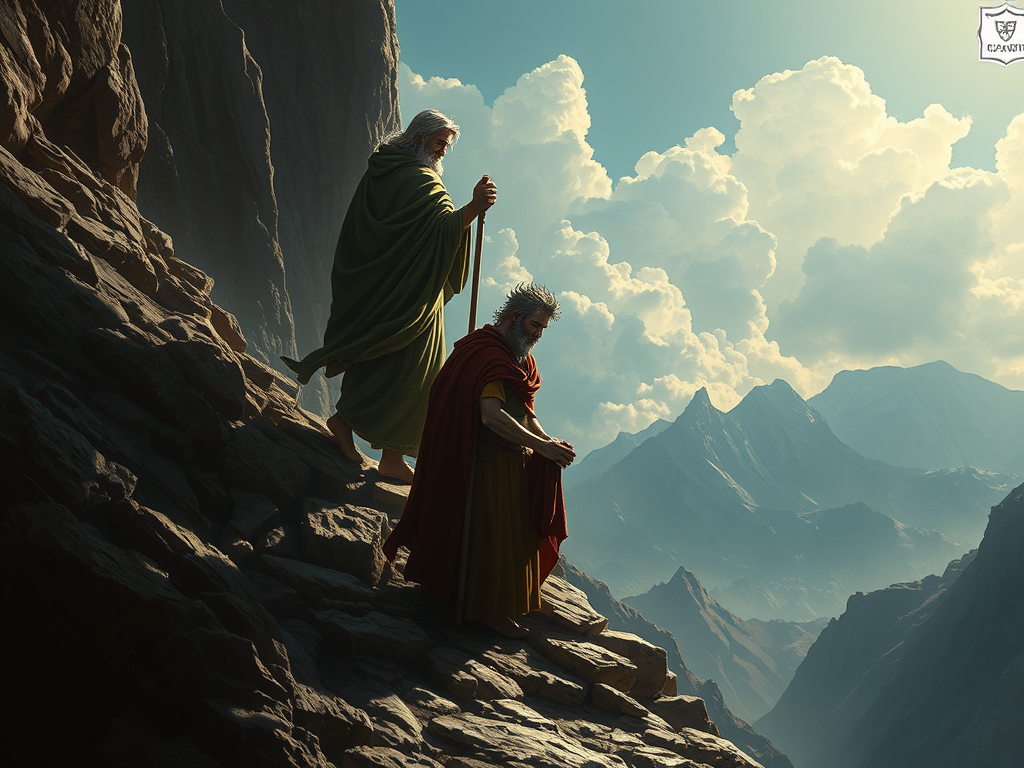

*‘Now you must needs,’ my teacher said, ‘shake off your wanted indolence.
No fame is won beneath the quilt or sunk in feather cushions.
Whoever, famous, wastes his life away,
leaves of himself no greater mark on earth
than smoke in air or froth upon the wave.
So upwards! On! And vanquished laboured breath!
In any battle mind-power will prevail,
unless the weight of body loads it down.’*
These words are spoken by Virgil to Dante during the ascent of Purgatory. Not Hell. That distinction matters more than people realise.
Hell is static. No one is urged upward there. No one is told to gather themselves, to breathe through the exhaustion, to keep going. Hell is gravity without resistance. Purgatory, by contrast, is where resistance returns. It is where effort becomes meaningful again.
Dante is tired. His body is failing him. The climb is real, not symbolic. And Virgil does not soothe him. He does not validate Dante’s fatigue. He tells him—plainly—to get moving. To throw off chosen indolence. Not imposed suffering, but the kind we quietly consent to when comfort starts to feel like virtue.
That phrase stays with me: wanted indolence.
Not weakness. Not collapse. Choice.
Virgil’s warning is blunt. A life spent avoiding effort leaves no enduring trace. It dissipates. Smoke. Froth. Nothing you could point to later and say, this mattered.
There was a time in my life when this truth stopped being theoretical.
I was facing a serious court case. The accusations, the uncertainty, the financial and psychological cost of it all were immense. I felt flattened by it. It had the texture of hell: dark, airless, degrading.
I remember sitting with my lawyer, Jonathan. He looked at me and saw what I was trying to hide. He didn’t offer reassurance. He didn’t minimise the situation. Instead, he said this:
“Malcolm, when you wake up each morning—especially when everything feels too dark and too hard—I want you to turn yourself to the side of the bed, put your feet on the floor, stand up, and start walking.”
That was it. No inspiration. No motivational overlay. Just movement.
Nothing about that advice made my life easier. But it restored the only thing that mattered at that point: agency. The next step. The refusal to lie down and disappear.
That is Virgil’s role. He doesn’t remove the mountain. He reminds you that you can still climb it.

Good advice never makes life easier. If anything, it adds weight. It introduces obligation. It demands effort when giving up would be simpler.
This is why most modern advice is hollow.
We live in a culture saturated with guidance that costs nothing to receive and demands nothing in return. Influencers, slogans, meme-ready insights—wisdom flattened into something instantly consumable. Advice engineered for circulation rather than truth.
But wisdom does not survive that process. As Søren Kierkegaard warned, “the crowd is untruth.” The moment guidance is shaped for mass appeal, it loses the precision required for the one.
Virgil does not speak in generalities. He speaks to Dante’s condition—this body, this breath, this hesitation on this slope. Real guidance is always local. Situated. Costly.
Advice that survives only by being simplified is rarely advice worth following.
I learned this again in a different register through my own neurodivergence.
I do not always read social situations well. Furthermore, I can be intense. Focused. Too much for certain environments. Over time, experience has taught me restraint, but there was a period when a friend offered what he believed was constructive advice: I should simply imitate him. His manner. His way of being. His social instincts.
I tried. Briefly. It was unbearable.
I could not become someone else without undoing myself. What he offered was not wisdom, but cheap grace—advice that reduced complexity rather than engaging it. Advice that suited him, not me.
Over time, it became clear that my difference unsettled him. His solution was conformity. Not understanding. Not discernment. Erasure.
This is the danger of false guides. They do not ask you to carry your own burden more faithfully. They ask you to carry theirs.
Virgil never asks Dante to become Virgil. He insists that Dante become more fully Dante, even if it costs him sweat, breath, and fear.
So choose your guides carefully.
A guide does not make your life smoother. A guide is someone who has walked through their own darkness without being consumed by it. Someone who understands cost, resistance, and the slow, unglamorous work of becoming.
Your Virgil may be a living person, or someone long dead. A family member. A philosopher. A theologian. For me, ultimately, it is the Lord Jesus Christ—not because he offers escape from suffering, but because he shows how to walk through it without surrendering the soul.
And remember: a guide is not always for life. Sometimes they appear only when you are lost in your own particular hell. Their task is not to carry you. It is to point and say, Upwards. On.
A guide is not a replacement for your will, nor a substitute for your responsibility. They do not remove the mountain or soften the climb. A guide, therefore, is embodied wisdom—resistant to meme-ification—that directs you toward the needed agency for the next step required for a flourishing existence.

Disclaimer: I know I’ve covered this theme before. But recently, I’ve seen it happen again—and badly. Terrible events, people dying, all of it twisted into cheap memes, flattened, politicised, stripped of consequence. It’s exhausting to watch. Complex, tragic circumstances reduced to foolishness that thrives on division, polarisation, and rhetoric designed to degrade rather than illuminate. I’m reiterating this not for novelty, but because the stakes are real. The way we treat wisdom—our guides, our attention—can literally cost lives.



Leave a Reply