
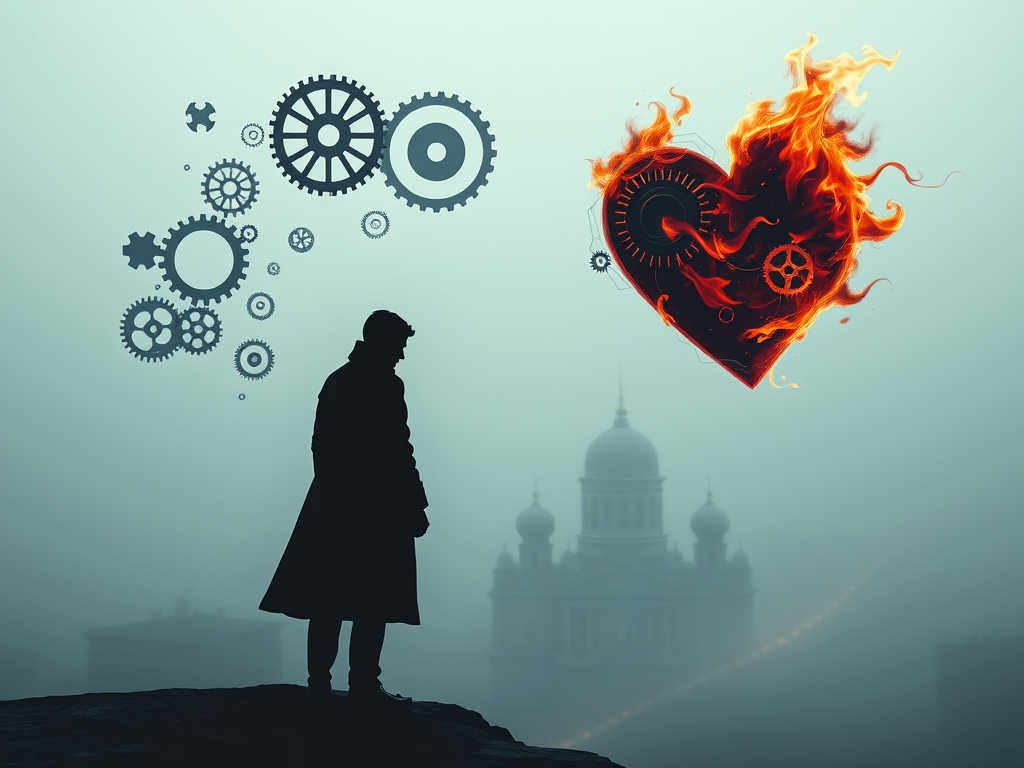

“You see, gentlemen, reason is an excellent thing, there’s no disputing that, but reason is nothing but reason and satisfies only the rational side of man’s nature, while will is a manifestation of the whole life, that is, of the whole human life, including reason and all the impulses.”
(Dostoevsky, F ‘Notes From Underground.’)
One of my favourite all-time short stories is Dostoevsky’s ‘Notes From The Underground’. Let me do a quick summary of this short story, and what philosophical point this story is trying to make (actually, in my opinion, it is made well.)
Plot Summary:
“Notes from Underground” is told from the perspective of an unnamed, retired civil servant living in isolation in St. Petersburg. The story is divided into two parts. In Part 1, the Underground Man launches a bitter and rambling attack on rationalism, utopianism, and the idea that human behaviour can be predicted and controlled by reason. He revels in his spitefulness and self-loathing, arguing that suffering and irrationality are essential aspects of human consciousness. In Part 2, he recounts specific incidents from his past that illustrate his alienation and his inability to connect with others, including a disastrous dinner with former schoolmates and a painful encounter with a prostitute named Liza.
Philosophical Meaning Summary:
“Notes from Underground” is a profound exploration of human nature and the limitations of reason. Dostoevsky uses the Underground Man to critique the Enlightenment’s emphasis on rationality and progress, arguing that humans are fundamentally irrational beings driven by will, desire, and a need for freedom, even if that freedom leads to suffering. The story suggests that utopian schemes based solely on reason are doomed to fail because they ignore the complexities and contradictions of the human psyche. Ultimately, “Notes from Underground” is a defence of individual freedom and the importance of embracing the full spectrum of human experience, even the unpleasant parts. It highlights the inherent tension between reason and will, suggesting that true humanity lies in the embrace of both.
So, what exactly is the will? It’s all those impulses, conscious and subconscious, that drive us. It shapes our ways of being, how we express ourselves, and the worldviews we hold. Furthermore, it’s the engine of human existence, fuelled by both instinct and reason. To claim we are merely rational beings is to fundamentally misunderstand what it means to be human and to create a false and limiting category of human existence.
This debate isn’t new. Throughout the history of philosophy, there’s been a tension between those who see humans as primarily instinctual beings and those who emphasise our rationality. Diogenes, for example, believed that true humanity lay in embracing our impulses, even living like a dog to highlight his rejection of societal norms. On the other hand, thinkers like Plato and Aristotle argued that reason is the defining characteristic of humanity, and that developing our rational faculties is the key to a fulfilling life.
But whatever the philosophical view, whether it’s the radical naturalism of Diogenes or the structured rationalism of Plato and Aristotle, at the heart of it all lies the will. It’s the driving force that compels us to live out what we believe to be reality and to define how we ought to function – within human society and within our own internal world. Ultimately, all these philosophies merely reflect the wilfulness of how people choose to live their lives.
However, it’s also important to acknowledge that some philosophers have conceived of the will as something far more abstract. Arthur Schopenhauer, for example, saw the will as a blind, irrational force that underlies all existence. He declared that ‘the will alone is a thing in itself.’ This means that, to Schopenhauer, the will is not simply a human faculty, but rather the fundamental reality underlying all phenomena. Yet, to view the will solely as this ethereal force is, to me, another extreme. It risks disconnecting the will from the lived experience of being human, from the interplay of reason, emotion, and action that shapes our individual lives. (Schopenhauer, Arthur. The World As Will And Idea (Vol. 1 of 3) (p. 57). Kindle Edition.)
While some philosophers, like Schopenhauer, have conceived of the will as a fundamental, underlying force, and others have focused on its role in reason and decision-making, I believe that the human being is best understood as a unified whole. There is no separation between the body, the soul, the spirit, the mind, the will, or the impulses. Each aspect influences and is influenced by all the others. These elements are, in fact, what it means to be human. The human being is the point – the totality of how we function and fit into the world. We are embedded creatures who exist in a totality, engaged with each other and engaged with the world we inhabit. And as such, we are simply the human-be-ing expressing itself in countless ways of being.
In practice, this means that as human beings, we’re constantly immersed in a world that presents us with choices. These choices come to us through our bodies, minds, worldviews, cultures, and languages – all constantly interacting. It’s our entire being – mind, body, soul, and spirit – that engages with these choices. Even a simple thought can trigger biological changes, altering our brain structure and influencing our actions. This highlights the fundamental truth that the part affects the whole, and the whole is present within the part.
This view of interconnectedness is also reflected in my Christian faith. Based on Romans 8 and Paul’s understanding of the new creation, even the physical creation itself will be renewed. At the heart of our faith is the belief in resurrection, and the writings of Paul and Peter suggest that the whole of creation will be transformed, including the human body. This resurrected body, while different in its unfallen state, is still the whole body – physical, mental, spiritual, and soulful. It represents the totality of human- be-ing and interaction, still embedded in creation. Therefore, in Christian thought, there is no separation between the ideal spiritual existence and the real physical existence. They become one expression in Christ, reflecting the ultimate unity of all things.
As I stated earlier, the will is an integral part of the whole human being. Therefore, we must be careful not to elevate reason, emotion, instinct, or any other aspect of our being as superior to the others. It is within this wholeness that we exist, and it is this wholeness that we should celebrate and engage with in life. When we separate one aspect of our being from another, it creates imbalance and disconnects us from the integrated life exemplified by Christ. He was fully engaged in the social, creative, physical, and material aspects of the world, as well as the mental, rational, emotional, and solitary dimensions. Instead of viewing the will as something separate, let us consider it as a manifestation of all these ways of being. The will is the phenomenon of human reality expressing itself internally to the individual, as well as externally upon the earth, society, and the interconnections we share.
Therefore, let us embrace the fullness of our humanity, recognising that the will is not a separate faculty but a manifestation of our integrated being. And let us not neglect the importance of character development, for it is through the cultivation of virtue and wisdom that we shape our will and align it with what is good. Our character informs our will, and our will, in turn, shapes our character, creating a virtuous cycle of growth and transformation. As Dostoevsky suggested, the will, with all its impulses and desires, may be more fundamental to our actions than rationality alone. By acknowledging the interconnectedness of our minds, bodies, souls, and spirits, we can move beyond a fragmented view of ourselves and embrace the wholeness that defines us as human beings.
I will end with one more thought: It is not always your free will that is important, but your free won’t which will define you.



Leave a Reply